
Most buyers get burned — not by bad intentions, but by broken chains of information. The choice is not just about price. It’s about control.
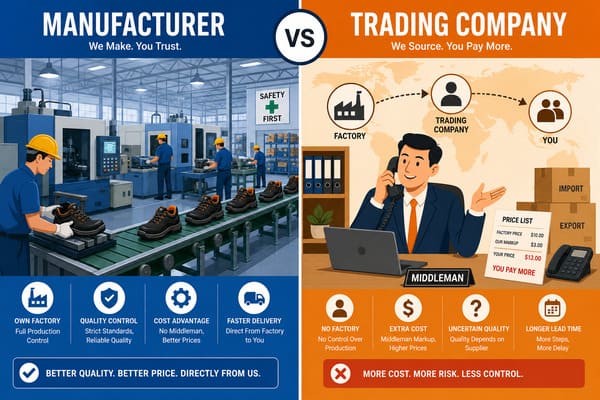
Working directly with a safety shoe manufacturer gives you control over quality, customization, and communication. A manufacturer owns the machines, the workers, and the process. A trading company owns a phone and a price list. That difference affects every order you place.
I’ve been in this industry for over 20 years. I started on the factory floor. I’ve watched good buyers make the same mistake — choosing the cheaper quote without understanding what they were actually buying1. By the time you finish reading this, you’ll know exactly what questions to ask and why the answer matters more than the price on the proforma invoice.
What Is the Difference Between a Safety Shoe Manufacturer and a Trading Company?
The distinction sounds simple. But most buyers don’t feel the difference until something goes wrong — and by then, the damage is already done.
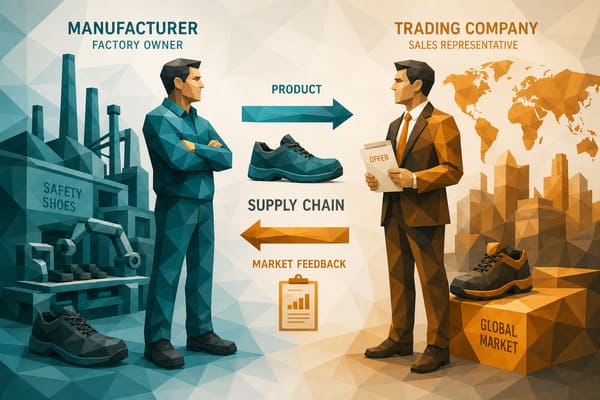
A manufacturer owns the production line, the workers, and every step of the process. A trading company sources from whoever gives them the best margin that month. When you order from a trading company, you may not be ordering from the same factory twice — even if the product looks identical.
I had a buyer — a PPE distributor from Eastern Europe — who came to me after two years with a trading company. He had ordered the same style three times. Each time, the shoes looked the same on the outside. But the sole hardness was different every batch. The trading company had quietly switched factories twice without telling him. His end customers noticed. Returns started coming in. He lost a key retail account over it.
That distributor is still our client today — four years later. Because consistency is something only a manufacturer can guarantee.
Why Does Factory Switching Happen So Often?
Trading companies are margin-driven. They don’t own the factories they work with. When a factory raises its price, the trading company finds another one.2 They have no reason to tell you. From their side, the product looks the same. From your side, the spec may have quietly changed.
Here’s what changes when a factory switches mid-relationship:
| What Changes | Why It Matters |
|---|---|
| Raw material supplier | Sole compound, upper leather grade may differ |
| Production line workers | Bonding quality, stitching consistency affected |
| QC standards | Pass/fail thresholds may not match your spec |
| Certification scope | The cert on file may not cover the new factory’s output |
At Shoegan, we run the same line, the same materials, and the same QC checkpoints on every single order. We have over 15 years of production experience in this facility. When you place a repeat order with us, you’re not hoping it matches the last one. You know it will.
Why Does Price Transparency Matter When Sourcing Safety Shoes?
A lower price feels like a win — until you find out what was left out to get there. That’s not a hypothetical. It happens more than most buyers realize.
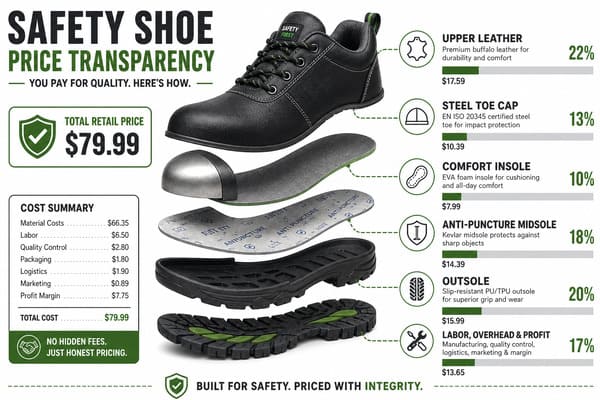
Price transparency means knowing what is inside every dollar of your quote. In safety footwear, the difference between a $18 pair and a $22 pair is often not profit margin — it’s material specification. And in certified safety shoes, a cheaper material can mean a real compliance failure.
I had a client from the Middle East who had been buying EN ISO 20345 certified safety shoes3 from a trading company for three years. The price was around $18 FOB per pair. When he came to us and we walked through the cost structure together, he realized something. At that price point, the midsole anti-puncture layer could not be a full 1.1mm steel plate meeting the standard’s requirements. It was a thinner, cheaper insert. The certificate on file was real — but it was issued for a slightly different spec than what was actually being shipped4.
That’s a compliance risk that could shut down a job site.
What Does a Safety Shoe Actually Cost to Build Correctly?
When we quote a pair of EN ISO 20345 certified safety shoes, the price reflects specific material choices. Here is a simplified breakdown of where the cost goes:
| Component | What Matters | What Gets Cut in Cheap Versions |
|---|---|---|
| Steel or composite toe cap | Impact resistance rating (200J) | Thinner cap, lower grade steel |
| Anti-puncture midsole | Full-coverage 1.1mm steel plate | Partial insert, thinner material |
| Outsole compound | Slip resistance, heat resistance | Recycled compound, thinner profile |
| Upper leather | Grade, thickness, breathability | Split leather, synthetic substitutes5 |
| Certification scope | Applies to actual shipped spec | May cover a different sample |
Our quote to that Middle East client was $22. But he knew exactly what was inside every dollar of that $22. He’s been ordering from us for two years since. That’s what price transparency actually buys you.
Can a Safety Shoe Manufacturer Really Offer Better Customization?
Most buyers assume customization means choosing a color and adding a logo. That’s decoration. Real customization is something else entirely — and it’s only possible when you own the process.
A safety shoe manufacturer can customize the last, the outsole, the toe cap type, the material spec, and the certification scope. A trading company can change what the shoe looks like. A manufacturer can change what the shoe is.
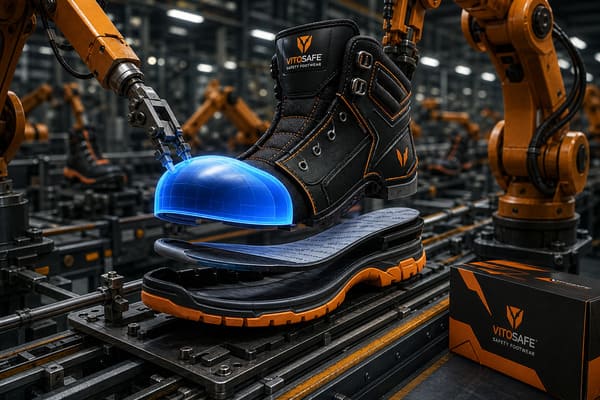
A construction equipment brand came to us wanting to build a co-branded safety shoe line for their dealer network across Southeast Asia. Their requirements were specific. The shoe needed to match their brand’s orange-and-black color scheme. It needed a composite toe instead of steel, so their service technicians could pass through airport security6 with carry-on tools. And it needed to be certified to both EN ISO 20345 and AS/NZS 2210 for their Australian market7.
A trading company would have told them to pick from an existing catalog. We built it from scratch.
What Does Full Customization Actually Include?
Here’s what we controlled in that project — and what a trading company simply cannot offer:
| Customization Element | What We Did | What a Trading Company Can Do |
|---|---|---|
| Last (shoe shape) | New last developed for fit profile | Use existing last only |
| Toe cap material | Composite, aviation-compliant spec | Steel or existing composite options |
| Outsole color | Custom orange-black blend | Limited standard colors |
| Certification | Dual-certified EN ISO 20345 + AS/NZS 2210 | Single cert from existing stock |
| Packaging | Fully branded box with dealer info | Generic box with label |
| MOQ | 500 pairs | Often higher, less flexible |
We delivered the finished product in 47 days. That’s what owning the production process actually means. When you work with a manufacturer directly, customization is a conversation between you and the people running the machines — not a game of telephone through a middleman.
How Does Quality Control Differ Between a Manufacturer and a Trading Company?
Quality control sounds like a checkbox. For a trading company, it often is. For a manufacturer, it’s built into every stage of production — because we’re the ones accountable when something fails.
A trading company sends a third-party inspector for one day before shipment. A manufacturer runs QC at every stage of production — incoming materials, in-process bonding, toe cap insertion, and final batch testing. The difference is not just thoroughness. It’s accountability.
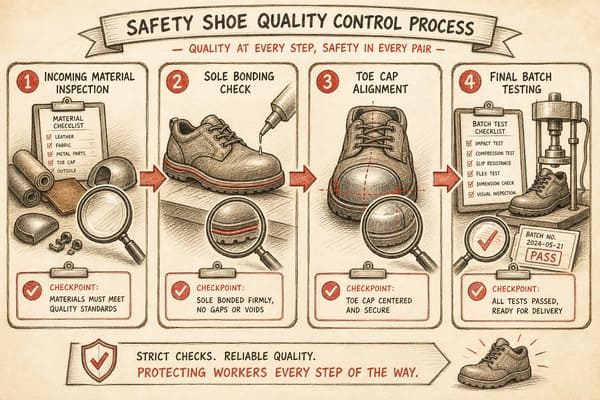
I spent eight years on the production side before I ever sold a single pair of shoes. I know exactly where safety shoes fail. And it’s almost never the part a third-party inspector checks on day one of a pre-shipment visit.
Where Safety Shoes Actually Fail — And Where QC Must Happen
A third-party inspector checks visible defects, counts pairs, and runs a few pull tests. That’s not enough. Here’s where real failures happen — and when they need to be caught:
| Failure Point | When It Must Be Checked | Who Catches It |
|---|---|---|
| Raw material variance | Before production starts | Manufacturer’s incoming QC |
| Sole bonding delamination | During bonding stage | In-process line supervisor |
| Toe cap misalignment | During lasting and assembly | In-process QC checkpoint |
| Slip resistance compliance | Batch sample testing | Pre-shipment lab test |
| Final spec match | Before container loading | Final random pull |
At Shoegan, we run four built-in QC stages: incoming raw material inspection, in-process checks at sole bonding and toe cap insertion, pre-shipment batch testing, and a final random pull before the container is loaded.
Two years ago, a client had a heel detachment issue — 12 pairs out of a 2,000-pair order. We traced it back to a single bonding temperature variance on one production shift. We replaced all 2,000 pairs, not just the 12. Because when you own the factory, accountability is not optional. It’s the only way to operate.
Conclusion
The choice between a manufacturer and a trading company is a choice between control and uncertainty. Price is just one variable — and often the least important one.
At Shoegan, we are a mid-to-high end safety shoe manufacturer with 15+ years of production experience, full OEM/ODM capability, and certifications covering EN ISO 20345, ASTM F24138, AS/NZS 2210, and more. If you want to know exactly what you’re buying — contact us at [email protected] or WhatsApp +8613008988018. Built to Protect. Made to Last.
-
"Strategic customer behavior, commitment, and supply …", https://repository.upenn.edu/bitstreams/1e253837-9155-4476-9363-d7454a2858ac/download. Procurement and supply chain management research documents a persistent tendency among buyers to optimize for unit purchase price rather than total cost of ownership, a bias that can obscure downstream quality, compliance, and rework costs when sourcing manufactured goods. Evidence role: general_support; source type: research. Supports: B2B procurement research shows that buyers frequently over-weight unit price relative to total cost of ownership, including quality, compliance, and switching costs. Scope note: Empirical studies on this bias are more developed in general procurement literature than in the safety footwear sector specifically. ↩
-
"Toward a conceptualization of supplier-switching processes … – PMC", https://pmc.ncbi.nlm.nih.gov/articles/PMC7148700/. Supply chain management literature identifies supplier switching by intermediaries as a documented risk factor in global sourcing, particularly where buyers lack direct contractual relationships with manufacturers and traceability mechanisms are absent. Evidence role: general_support; source type: research. Supports: Intermediary trading companies in global supply chains may change sub-suppliers without buyer notification, creating quality consistency and compliance risks. Scope note: Academic literature on this specific behavior in the safety footwear sector is limited; broader supply chain studies from apparel or electronics may provide the closest empirical analogy. ↩
-
"What Questions Should You Ask a Safety Shoe Supplier …", https://protectyourfootsafety.com/what-questions-should-you-ask-a-safety-shoe-supplier/. ISO 20345 specifies fundamental and additional requirements for safety footwear used in conjunction with personal protective equipment, including a 200-joule toe cap impact resistance requirement and anti-puncture midsole provisions, as published by the International Organization for Standardization. Evidence role: definition; source type: institution. Supports: EN ISO 20345 defines minimum performance requirements for safety footwear, including toe cap impact resistance and anti-puncture midsole specifications. Scope note: The standard itself is a paid document; secondary sources such as national standards bodies or regulatory summaries may provide only partial specification details. ↩
-
"CE Marking", https://www.trade.gov/ce-marking. Under EU Regulation 2016/425 on personal protective equipment, CE certification is granted based on type examination of a representative sample; manufacturers are obligated to ensure ongoing production conformity, and certification does not automatically validate products that deviate from the tested specification. Evidence role: mechanism; source type: government. Supports: Product certifications, including CE marking for PPE, are issued against a specific tested sample and require ongoing production controls to ensure shipped goods conform to the certified specification. Scope note: This mechanism is documented under EU regulatory frameworks; application in other jurisdictions or under other certification schemes may differ in procedural requirements. ↩
-
"Grain Characteristics Comparison of Different Types of Shoe Upper …", https://www.academia.edu/121416960/Grain_Characteristics_Comparison_of_Different_Types_of_Shoe_Upper_Leathers. Leather science literature and industry grading standards classify full-grain leather as retaining the original grain surface and exhibiting superior tensile strength and moisture resistance compared to split leather, which lacks the outer grain layer and is generally associated with reduced durability in load-bearing footwear applications. Evidence role: general_support; source type: research. Supports: Leather grading systems distinguish full-grain, top-grain, and split leather by durability, breathability, and structural integrity, with split leather generally considered inferior in abrasion resistance and longevity for footwear applications. Scope note: Performance differences between leather grades in safety footwear depend on finishing treatments and end-use conditions; no single universal standard mandates leather grade minimums in EN ISO 20345 or equivalent safety footwear specifications. ↩
-
"Steel Toe Boots | Transportation Security Administration – TSA", https://www.tsa.gov/travel/security-screening/whatcanibring/items/steel-toe-boots. Transportation security guidance and materials science literature confirm that composite toe caps, composed of non-metallic materials such as carbon fiber or Kevlar, do not activate standard metal detection equipment, unlike steel toe caps. Evidence role: general_support; source type: government. Supports: Composite toe caps are made from non-metallic materials and are generally not detected by standard metal detection equipment used in airport security. Scope note: Security screening outcomes can vary by airport, equipment sensitivity, and footwear design; no single government source universally guarantees composite toe caps will not trigger all security systems. ↩
-
"What Should You Check Before Ordering Custom Safety Shoes …", https://protectyourfootsafety.com/what-should-you-check-before-ordering-custom-safety-shoes/. AS/NZS 2210, developed jointly by Standards Australia and Standards New Zealand, sets out performance requirements for occupational protective footwear and is referenced in Australian workplace health and safety regulations governing personal protective equipment. Evidence role: definition; source type: government. Supports: AS/NZS 2210 is the jointly adopted Australian and New Zealand standard governing the performance requirements for occupational protective footwear. Scope note: Regulatory enforcement of AS/NZS 2210 varies by jurisdiction and industry sector within Australia; compliance requirements should be verified against applicable state or federal workplace safety legislation. ↩
-
"Employer Personal Protective Equipment Workplace Hazard …", https://www.osha.gov/laws-regs/standardinterpretations/2013-12-09. ASTM F2413, published by ASTM International, establishes minimum requirements for the design, performance, testing, and classification of protective footwear used in occupational settings, and is the predominant safety footwear standard referenced in United States workplace safety regulations. Evidence role: definition; source type: institution. Supports: ASTM F2413 is the primary American standard specifying minimum requirements for the design, performance, testing, and classification of protective footwear. ↩