
I started on the factory floor, not in a sales office. Buyers kept coming back to me directly — not for price, but because they knew I’d tell them the truth.
Building a long-term relationship with a safety shoe manufacturer starts with finding someone who knows production, communicates honestly, and treats your order as a technical problem to solve — not just a transaction to close.
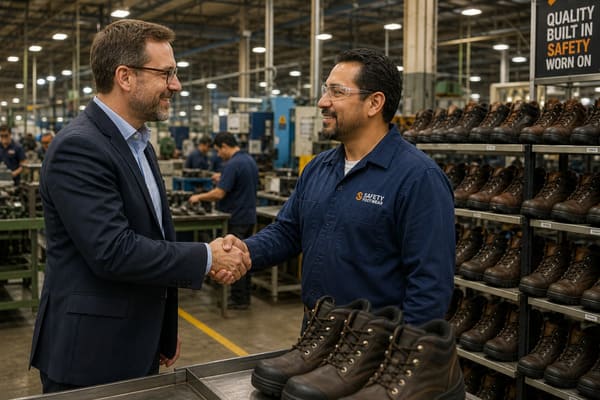
One buyer told me something I’ve never forgotten: "I don’t care who the factory is. I care that you’re the one checking the quality." That sentence changed how I think about this business. Long-term supplier relationships aren’t built between companies. They’re built between people.1 And the foundation is always the same: does this person actually know what they’re doing, and will they tell me the truth? The rest of this article breaks down exactly how that kind of relationship gets built — and what destroys it.
What Makes a Safety Shoe Manufacturer Worth Trusting Long-Term?
Most suppliers look the same on paper. The difference only shows when something goes wrong — and something always goes wrong eventually.
A safety shoe manufacturer worth trusting long-term is one who tells you the truth before you ask, gives you real options when problems come up, and treats your compliance requirements as non-negotiable — not as variables to work around.
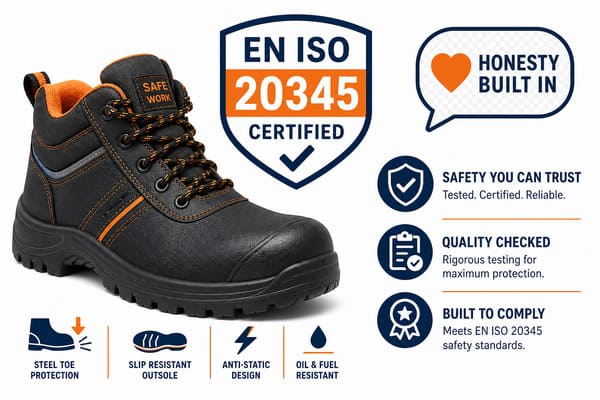
I remember a specific order — about 3,000 pairs for a European distributor. Midway through production, our usual outsole supplier ran short on a key raw material. We had two options: delay the order by 10 days, or swap in a similar material from a backup supplier without telling the buyer. A lot of factories would have taken option two. We took option one. We called the buyer the same day, explained the situation, showed them the material spec comparison, and let them decide. They chose the 10-day delay. That order shipped, passed all EN ISO 20345 testing2, and that buyer has reordered with us six times since.
Why Transparency in Production Is a Business Asset
Transparency sounds like a moral virtue. In manufacturing, it is also a practical one. When a supplier hides a production problem, it rarely stays hidden. The shoe arrives, the end user notices something is off, and the buyer has to explain a defect they didn’t know existed. That situation is far more damaging than a 10-day delay.
| Situation | Short-Term Cost | Long-Term Impact |
|---|---|---|
| Hiding a material substitution | Zero delay | Risk of product failure, certification gap, lost client |
| Disclosing and asking for decision | 10-day delay | Buyer trust maintained, repeat orders likely |
| Proactive material spec comparison | Small admin time | Demonstrates technical knowledge and honesty |
The buyers who stay with us longest are not the ones who never had a problem. They are the ones who saw how we handled a problem. Trust is built in those moments — not in brochures, not in certifications, not in factory tour photos3. When a manufacturer walks you through a difficult situation without hiding anything, that is the most reliable signal you will get about who you are dealing with.
How Does Clear Communication Prevent Safety Shoe Order Problems?
Order problems rarely start in production. They start in the conversation before production — or the conversation that never happened.
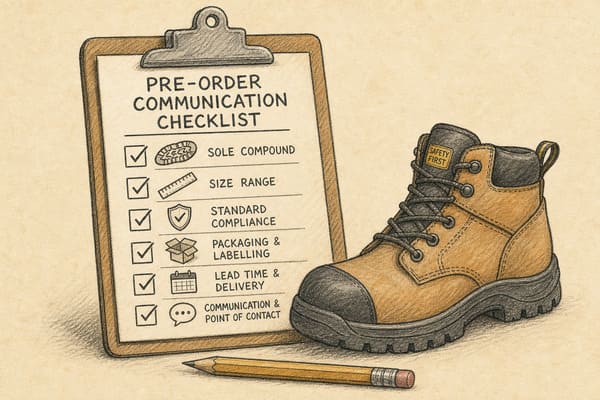
Clear communication prevents safety shoe order problems by making sure the end-use environment, required standard, sole compound, and size distribution are confirmed before production starts — not after the shoes have already shipped.
Early in my export business, I took an order from a Middle Eastern buyer — 1,200 pairs of steel toe safety shoes. The spec sheet said "oil resistant sole4." I confirmed it and moved to production. When the shoes arrived, the buyer came back upset. Their workers were on petrochemical sites, and they needed a sole that met specific fuel oil resistance standards — not just general oil resistance. The end use was never discussed. That order cost both of us time and money to resolve.
The Pre-Order Checklist That Changed Our Order Process
After that experience, I built a standard pre-order checklist. It covers 14 specific questions before any production starts. Since we started using it, our order revision rate dropped by more than 60%5.
| Checklist Area | Why It Matters |
|---|---|
| End-use environment | Determines required protection class and sole compound |
| Applicable standard | EN ISO 20345, ASTM F2413, AS/NZS 2210, GSO — each has different requirements |
| Sole compound specification | "Oil resistant" and "fuel oil resistant" are not the same |
| Lining material preference | Affects breathability, moisture control, and long-term odor |
| Size range and distribution | Incorrect size ratio is one of the most common reorder complaints |
| Packaging and labeling requirements | Custom retail box, bulk pack, barcode placement — each must be confirmed |
The pattern behind most order problems is the same. One side assumed. The other side didn’t ask. A short, structured conversation at the start of the order removes most of that risk. One conversation upfront saves ten conversations later. That is not an estimate — our numbers support it.
How Does OEM Customization Strengthen Your Supplier Relationship?
A buyer who has built a product with you is not the same as a buyer who picked a style from a catalog. The investment is different. The relationship is different.
OEM customization strengthens your supplier relationship because both sides invest time, technical decisions, and brand identity into a product6 that only exists because of that specific partnership — making it costly and disruptive for either side to walk away.
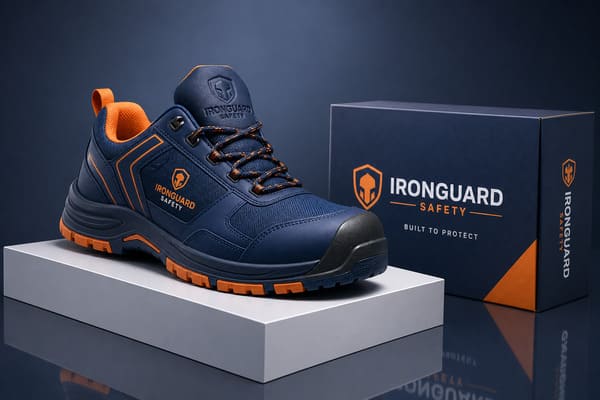
One of our current long-term clients started with a trial order of 500 pairs — their logo embossed on the tongue, a custom colorway, and their own box design. It took us three rounds of samples to get the color exactly right. The buyer was patient. We were honest about each round’s issue. By the time the first production order shipped, both sides had already invested real time in each other. That buyer now places four orders a year with us, averaging 2,000 pairs per order. They haven’t asked for a price comparison from another supplier in two years.
What the OEM Process Actually Builds Between Buyer and Supplier
The reason that buyer stopped shopping around is not loyalty in the sentimental sense. It is that switching suppliers would mean rebuilding everything — reapproving color specs, re-communicating packaging requirements, re-explaining the size distribution, and hoping the new supplier handles the first problem as well as the current one does.
| OEM Investment Stage | What Gets Built |
|---|---|
| Sample development | Shared technical knowledge about the product |
| Color and material approval | A documented record of decisions both sides made together |
| First production run | Confidence that the manufacturer can execute to spec |
| Repeat orders | Operational efficiency — fewer questions, faster setup |
| Branded packaging | Visual identity tied to a specific supply chain |
At Shoegan, we support full OEM and ODM customization — design, logo, color, material, and packaging. Our MOQ starts at 500 pairs, and our standard lead time is 30 days. For custom styles, lead time varies depending on development complexity. The buyers who grow with us the most are usually the ones who started by building something that was actually theirs. Customization builds a wall around the relationship. It protects both sides.
What Are the Warning Signs of a Safety Shoe Manufacturer You Should Avoid?
A bad supplier doesn’t always look bad at the start. The signs are there — but they show up in small details most buyers overlook during the quoting stage.
The clearest warning signs of a safety shoe manufacturer to avoid are: prices quoted significantly below market without technical questions7, certifications that apply to sample batches rather than production batches, and no structured process for confirming end-use requirements before production starts.
A few years ago, a buyer came to me after a bad experience with another supplier. They had ordered 2,000 pairs of ESD safety shoes — anti-static, required for electronics manufacturing environments8. The shoes arrived, the buyer distributed them to the factory floor, and within three months the workers started complaining. The resistance values were off. The manufacturer had used a different sole compound in production to cut costs — a compound that looked identical but didn’t meet ESD performance specs. Nobody caught it until the shoes were already in use. That buyer lost the confidence of their end client and had to replace all 2,000 pairs at their own cost.
How to Read the Warning Signs Before You Place the Order
The warning signs were there earlier. The manufacturer had quoted 15% below market rate without asking a single technical question. That combination — low price and zero technical curiosity — is almost always a problem waiting to happen.
| Warning Sign | What It Usually Means |
|---|---|
| Quote 15%+ below market with no technical questions | Manufacturer is cutting material costs somewhere you haven’t approved |
| Certification covers sample batch only9 | Production batch was never independently tested |
| No pre-order checklist or spec confirmation process | Manufacturer is not tracking the details that prevent failures |
| Vague answers about which standard applies | Manufacturer does not have real compliance experience |
| Resistant to sharing material specs or test reports | Something in the supply chain is being hidden |
| No fixed point of contact for technical issues | No one is actually accountable for quality decisions |
At Shoegan, all our products are certified under the standards relevant to each market — EN ISO 20345 for Europe, ASTM F2413 for North America10, AS/NZS 2210 for Australia and New Zealand11, GSO for the Middle East, and GB 12011 for China12. Our certifications cover production batches, not just development samples. When a buyer asks for a test report, we provide the real one. Price without questions is almost always a problem waiting to happen — and we would rather lose a price-sensitive inquiry than deliver a product that fails in the field.
Conclusion
Long-term supplier relationships are built on honesty, clear communication, and products both sides built together — not on the lowest price. Shoegan is a mid-to-high end safety shoe manufacturer with 15+ years of production experience, full OEM/ODM capability, and certifications for every major global market — built to protect the people wearing our shoes, and the businesses selling them.
-
"Absence of personal relationship in a buyer-supplier relationship – PMC", https://pmc.ncbi.nlm.nih.gov/articles/PMC6558269/. A substantial body of research in industrial marketing, including foundational work by Dwyer, Schurr, and Oh (1987) and subsequent studies in the Journal of Marketing and Journal of Supply Chain Management, establishes that interpersonal trust and personal relationships between boundary-spanning individuals are central mechanisms in the development and maintenance of long-term B2B supplier partnerships. Evidence role: expert_consensus; source type: research. Supports: Academic research in B2B marketing and supply chain management supports that interpersonal trust between individuals is a primary driver of long-term supplier-buyer relationships. Scope note: Academic findings are drawn from diverse industries and contexts; the specific dynamics of footwear manufacturing supply chains may differ from the studied populations. ↩
-
"What Questions Should You Ask a Safety Shoe Supplier …", https://protectyourfootsafety.com/what-questions-should-you-ask-a-safety-shoe-supplier/. EN ISO 20345 establishes the fundamental performance requirements for safety footwear, including a minimum 200-joule impact resistance test for toecaps, and serves as the primary conformity standard for safety footwear placed on the European market. Evidence role: definition; source type: institution. Supports: EN ISO 20345 specifies basic and additional requirements for safety footwear used in professional environments, including impact and compression resistance for toe protection. Scope note: The standard itself is a paid ISO document; secondary sources such as national standards bodies or academic summaries may be used to verify its scope. ↩
-
"Mindful management of relationships during periods of crises – PMC – NIH", https://pmc.ncbi.nlm.nih.gov/articles/PMC7274625/. Studies in supply chain management and organizational behavior, including work published in the Journal of Operations Management, distinguish between calculative trust based on credentials and affective trust built through observed behavior, finding that supplier responses to disruptions and problems are disproportionately influential in forming durable buyer trust compared to pre-relationship signals such as certifications or facility presentations. Evidence role: expert_consensus; source type: research. Supports: Research on trust formation in supply chain relationships indicates that behavioral demonstrations during disruptions or problems are more influential in building trust than credentials or marketing signals. Scope note: The research literature covers trust formation broadly across supply chain contexts; direct empirical studies focused on the footwear manufacturing sector are not available, making this general support rather than direct proof. ↩
-
"What Should You Check Before Ordering Custom Safety Shoes …", https://protectyourfootsafety.com/what-should-you-check-before-ordering-custom-safety-shoes/. Under EN ISO 20345, outsole resistance classifications differentiate between resistance to vegetable oil (SRA), resistance to sodium lauryl sulphate solution (SRB), and combined resistance (SRC), while fuel oil resistance is tested separately under specific petrochemical exposure protocols, reflecting materially different chemical resistance requirements. Evidence role: definition; source type: institution. Supports: Safety footwear standards distinguish between general oil resistance and fuel oil resistance as separate performance classifications with different test methods. Scope note: The precise test method distinctions depend on the applicable standard version and market; the article’s petrochemical site scenario may involve additional industry-specific requirements beyond the base standard. ↩
-
"What Should You Check Before Ordering Custom Safety Shoes …", https://protectyourfootsafety.com/what-should-you-check-before-ordering-custom-safety-shoes/. Research in supply chain management has documented that formalized pre-production specification protocols between buyers and manufacturers significantly reduce order discrepancies, rework rates, and downstream quality failures, though specific percentage improvements vary by industry and implementation. Evidence role: general_support; source type: research. Supports: Structured pre-production communication and specification confirmation processes reduce order errors and revision rates in manufacturing supply chains. Scope note: The 60% figure cited in the article is an internal company claim; external research provides general support for the mechanism but cannot validate the specific statistic. ↩
-
"Impacts of switching costs", https://agribusiness.purdue.edu/2016/06/23/impacts-of-switching-costs/. Transaction cost economics, as developed by Williamson (1985) and applied extensively in supply chain research, predicts that asset-specific investments — including co-developed product specifications, tooling, and branded packaging — generate bilateral switching costs that stabilize buyer-supplier relationships by making unilateral exit economically costly for both parties. Evidence role: mechanism; source type: research. Supports: Asset-specific investments such as OEM customization create switching costs that increase relationship stability and reduce the likelihood of supplier switching in B2B contexts. Scope note: The theoretical framework describes the general mechanism; empirical studies on switching costs in footwear manufacturing specifically are limited, and the magnitude of the effect varies by investment level and market conditions. ↩
-
"Risk assessment in supply chains: a state-of-the-art review … – PMC – NIH", https://pmc.ncbi.nlm.nih.gov/articles/PMC9063627/. Supply chain risk literature, including studies published in the International Journal of Production Economics, identifies significant price deviation below market benchmarks as a leading indicator of hidden cost-cutting practices such as unauthorized material substitution, which correlates with downstream quality failures and compliance gaps. Evidence role: general_support; source type: research. Supports: Abnormally low supplier pricing relative to market rates is associated with increased risk of material substitution, quality failures, and non-compliance in manufacturing supply chains. Scope note: The specific threshold of ‘15% below market’ cited in the article is a practitioner heuristic rather than a research-validated figure; academic support covers the general mechanism rather than the specific percentage. ↩
-
"JSC-66552BASELINE.pdf", https://standards.nasa.gov/sites/default/files/standards/JSC/Baseline/0/JSC-66552BASELINE.pdf. IEC 61340-5-1 and related standards establish that electrostatic control footwear is a required element of personnel grounding systems in electronics manufacturing environments where electrostatic discharge can damage components or create ignition hazards. Evidence role: mechanism; source type: institution. Supports: ESD footwear is used in electronics manufacturing to dissipate electrostatic charge and prevent damage to sensitive components or ignition of flammable materials. Scope note: The specific resistance value thresholds vary by standard and application context; the article’s claim about ‘resistance values being off’ is consistent with but not directly proven by general ESD standards documentation. ↩
-
"How Do You Start a Private Label Safety Shoe Brand? – Shoegan …", https://protectyourfootsafety.com/how-do-you-start-a-private-label-safety-shoe-brand/. EU Regulation 2016/425 on personal protective equipment requires that Category II PPE, which includes most safety footwear, undergo EU-type examination of a representative sample followed by conformity to type assurance procedures covering production batches, meaning certification based solely on a development sample does not satisfy the full regulatory conformity requirement. Evidence role: mechanism; source type: government. Supports: Regulatory frameworks for personal protective equipment require conformity assessment that extends beyond initial sample testing to cover production consistency. Scope note: This regulatory mechanism applies specifically to the EU market; equivalent production batch requirements under ASTM, AS/NZS, or GB frameworks would require separate citation. ↩
-
"1910.136 – Foot protection. | Occupational Safety and Health …", https://www.osha.gov/laws-regs/regulations/standardnumber/1910/1910.136. ASTM F2413, published by ASTM International, specifies minimum performance requirements for the design, construction, testing, and classification of protective footwear intended for occupational use in the United States and Canada. Evidence role: definition; source type: institution. Supports: ASTM F2413 is the standard specification for performance requirements for protective footwear in North America. Scope note: The full standard text requires purchase; publicly available ASTM summaries or OSHA references may serve as accessible secondary sources. ↩
-
"What Should You Check Before Ordering Custom Safety Shoes …", https://protectyourfootsafety.com/what-should-you-check-before-ordering-custom-safety-shoes/. AS/NZS 2210, published jointly by Standards Australia and Standards New Zealand, specifies the requirements for occupational protective footwear sold in Australia and New Zealand, including impact resistance, compression resistance, and slip resistance classifications aligned with workplace health and safety regulations in both countries. Evidence role: definition; source type: government. Supports: AS/NZS 2210 is the joint Australian and New Zealand standard governing the design and performance requirements for occupational protective footwear. Scope note: Standards Australia documents require purchase; Safe Work Australia guidance documents or university occupational health resources may provide accessible secondary confirmation. ↩
-
"How Do You Choose a Safety Shoe Manufacturer in China …", https://protectyourfootsafety.com/how-do-you-choose-a-safety-shoe-manufacturer-in-china/. GB 12011, issued by the Standardization Administration of China (SAC) and enforced under China’s occupational safety regulatory framework, establishes mandatory performance requirements for safety footwear including toe impact resistance, compression resistance, and anti-static properties for products sold in the Chinese market. Evidence role: definition; source type: government. Supports: GB 12011 is the Chinese national mandatory standard for safety footwear, specifying performance requirements for occupational protective shoes sold in China. Scope note: English-language documentation of GB standards is limited; verification may require translation of official SAC publications or reference to Chinese government occupational safety agency guidance. ↩