
Static electricity killed a worker in a petrochemical plant1. The shoes were labeled "antistatic." But nobody checked the resistance range — and that one number made all the difference.
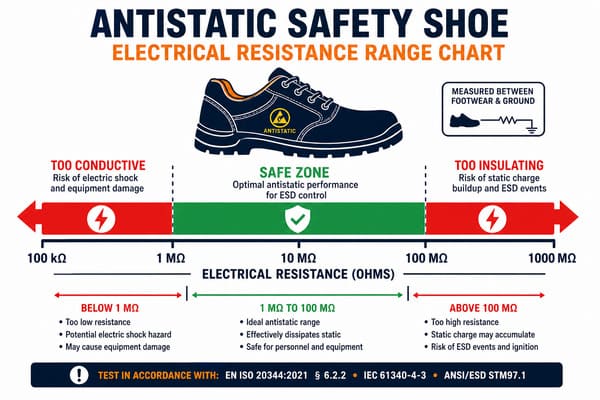
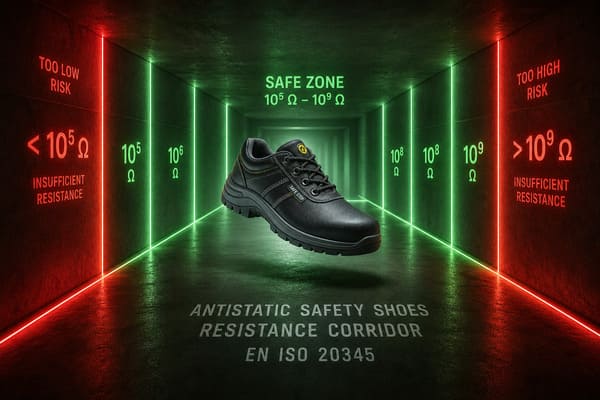
Antistatic safety shoes must fall within a resistance range of 100 kΩ to 1,000 MΩ under EN ISO 203452. Below 100 kΩ, the shoe becomes conductive and dangerous near live current. Above 1,000 MΩ, static charge cannot escape, creating spark risk in flammable environments.
The "antistatic" label is one of the most misunderstood terms in the safety footwear industry. I have had the same clarifying conversation at least a dozen times in the past two years alone. Buyers come to me with a label. I come back with a question. And that question — every single time — changes what they actually order. If you are sourcing safety footwear for industrial use, this article will walk you through what the numbers mean, how the categories differ, and why the workplace environment always has the final say.
What Is ESD Rated Footwear?
Most buyers assume ESD and antistatic mean the same thing. They do not. Confusing the two can shut down an entire electronics production line — or worse, damage equipment worth far more than the shoes themselves.
ESD-rated footwear is designed to protect sensitive electronic components from electrostatic discharge. Under IEC 61340-5-1, ESD shoes must measure below 35 MΩ when tested as part of a complete person-plus-shoe system3. This is a tighter, lower-resistance requirement than standard antistatic footwear.
A few years ago, an electronics factory buyer came to me after a frustrating experience with another supplier. He had ordered antistatic shoes for his PCB assembly line. His quality team failed them on arrival. The shoes carried a valid EN ISO 20345 antistatic certification — resistance between 100 kΩ and 1,000 MΩ — but his ESD-controlled workstations required footwear below 35 MΩ under IEC 61340-5-1. Both products could legally be called "antistatic." But they were built for completely different problems.
Why ESD Footwear Requires Its Own Standard
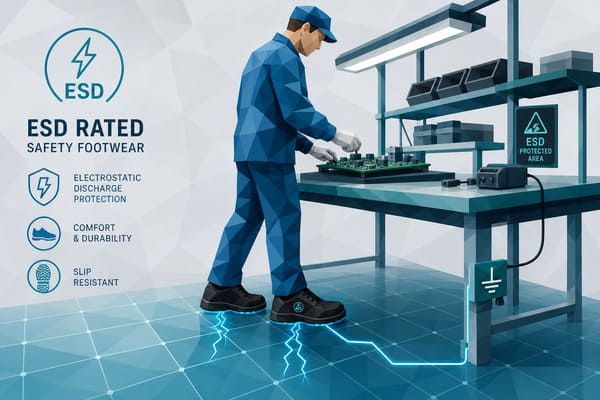
ESD-controlled environments are built around one goal: keeping electrostatic discharge below the threshold that damages microchips and circuit boards4. A human body walking across a floor can carry thousands of volts of static charge5. ESD footwear works as part of a grounded system — shoes, flooring, and wrist straps all working together — to drain that charge continuously and safely.
| Property | Standard Antistatic (EN ISO 20345) | ESD Footwear (IEC 61340-5-1) |
|---|---|---|
| Resistance range | 100 kΩ – 1,000 MΩ | < 35 MΩ (system test) |
| Primary hazard addressed | Flammable vapor ignition | Electronic component damage |
| Test method | Shoe only | Person + shoe system |
| Typical environment | Chemical, oil & gas, industrial | Electronics assembly, cleanrooms |
| Risk of wrong choice | Spark in flammable zone | Component failure, production loss |
The key difference is not just the number. It is the test method. ESD standards measure the entire person-shoe-floor system. Antistatic standards measure the shoe alone. A shoe that passes one test will not automatically pass the other. When I work with electronics industry buyers, I always ask for the floor resistance spec and the full system requirement before recommending a product. Matching the shoe to the floor is as important as matching the shoe to the foot.
Are Electrical Hazard Shoes the Same as ESD Shoes?
This is the single most dangerous mix-up I see in this industry. I encounter it three or four times a year, and every time, the consequences could have been severe.
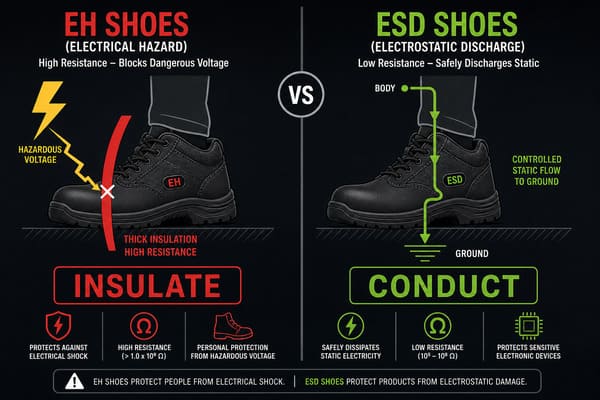
Electrical hazard (EH) shoes and ESD shoes are opposites. EH shoes insulate the wearer from electrical ground, with resistance above 1 MΩ, tested at up to 18,000 volts. ESD shoes conduct static charge away from the body. Wearing EH shoes in an ESD environment leaves charge trapped. Wearing ESD shoes near live current removes the insulation protecting the wearer.
Last year, a buyer from a Middle East distributor contacted me. He needed antistatic shoes for a petrochemical plant. I asked him one question: are your workers near live electrical panels, or near flammable gas? He went quiet. He did not know. That one question probably prevented a serious incident — because the answer determines whether you need a shoe that conducts or a shoe that insulates. Those are opposite products.
The Physics Behind EH vs. ESD
EH shoes are built to break the circuit between the wearer and the ground. If a worker accidentally contacts a live conductor, the shoe’s high resistance slows or stops current from flowing through the body to ground. Under ASTM F2413, EH-rated footwear is tested at 18,000 volts with no more than 1 mA of current leakage6.
ESD shoes are built to complete a controlled circuit. They allow charge to flow from the body, through the shoe, into a grounded floor — slowly and safely. If you put EH shoes on a worker in an ESD-controlled zone, static charge has nowhere to go. It builds up. It discharges suddenly. Components fail.
| Property | Electrical Hazard (EH) | ESD Footwear |
|---|---|---|
| Resistance level | Very high (> 1 MΩ, often much higher) | Low (< 35 MΩ) |
| Function | Insulate wearer from ground | Drain static from wearer to ground |
| Test voltage | Up to 18,000 V (ASTM F2413) | Low voltage system test |
| Right environment | Near live electrical equipment | Electronics assembly, cleanrooms |
| Wrong environment | ESD-controlled zones | Near live electrical conductors |
I always tell buyers: before you pick a category, describe the hazard. The shoe follows the hazard. The hazard does not follow the shoe.
Are ESD and Conductive Shoes the Same?
Buyers often group ESD and conductive shoes together because both have low resistance. That grouping is wrong, and in some environments, it is genuinely dangerous.
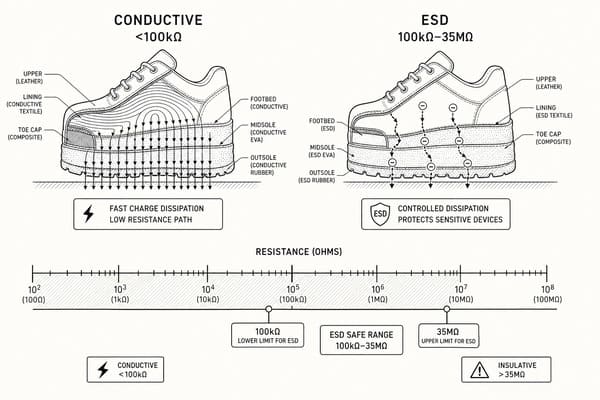
ESD shoes and conductive shoes are not the same. Conductive shoes measure below 100 kΩ7 and drain static almost instantly. ESD shoes fall between 100 kΩ and 35 MΩ and drain static in a controlled, slower way. Conductive shoes are not safe near any electrical equipment. ESD shoes are not safe near live current either, but they carry significantly less risk than conductive footwear.
I once tested a batch of shoes from another supplier on behalf of a client. Fifty pairs, claimed to be antistatic. Twelve of them tested below 100 kΩ. That put them in the conductive category. The supplier had no idea. Those shoes would have passed a visual inspection. They would have failed a life-safety test. And in a flammable gas environment, they would have been a real hazard.
Understanding the Full Resistance Spectrum
The easiest way to understand these categories is to lay them out as a single spectrum, from lowest to highest resistance.
| Category | Resistance Range | Primary Use | Key Risk if Misused |
|---|---|---|---|
| Conductive | < 100 kΩ | Specific explosive dust environments8 | Lethal near live electrical equipment |
| ESD | 100 kΩ – 35 MΩ | Electronics manufacturing | Component damage if too high; shock risk if near live current |
| Antistatic | 100 kΩ – 1,000 MΩ | Flammable vapor environments | Spark risk if too high; shock risk if too low |
| Electrical Hazard | > 1 MΩ (tested at 18 kV) | Near live electrical conductors | Static buildup in ESD zones |
Conductive shoes sit at the far low end. They drain charge so fast that any accidental contact with a live source sends current straight through the wearer. They have legitimate uses — certain explosive dust environments where very rapid static dissipation is required — but they are not a default choice, and they are never appropriate near electrical equipment of any kind. The difference between conductive and ESD is not just a number. It is the difference between controlled dissipation and uncontrolled conductance. I always walk clients through this spectrum before we discuss product specifications. The category comes first. The product comes second.
What Is the Standard Electrical Resistance Range for Antistatic Safety Shoes?
When clients ask me for the antistatic spec, they expect me to give them a single number. I always give them two numbers instead — and I explain why both matter equally.
Under EN ISO 20345, antistatic safety shoes must measure between 100 kΩ and 1,000 MΩ. This range is a safety corridor. The lower limit prevents the shoe from becoming conductive near live current. The upper limit ensures static charge can still escape in flammable or explosive environments.
I had a client buying for a mining operation in Australia. His spec sheet said "AS/NZS 22109, antistatic." I asked him three questions: Is there diesel fuel or explosive gas nearby? Are there exposed electrical conductors? Is there sensitive electronic equipment underground? He answered yes to the first two. That immediately ruled out conductive shoes and ESD shoes, and pointed us toward antistatic footwear with resistance comfortably above 100 kΩ, combined with an electrical hazard rating. No single standard answers all three questions at once.
How Standards Set the Floor — and Workplaces Set the Ceiling
Standards define the legal minimum. The workplace assessment defines the actual requirement. Skipping the workplace assessment is where most compliance failures happen.
| Standard | Region | Antistatic Resistance Range | Additional Notes |
|---|---|---|---|
| EN ISO 20345 | Europe | 100 kΩ – 1,000 MΩ | Most widely referenced globally |
| ASTM F2413 | USA / North America | EH rating tested at 18 kV | No antistatic corridor defined; EH is separate |
| AS/NZS 2210 | Australia / New Zealand | Aligned with EN ISO 20345 | Workplace risk assessment required |
| GB 1201110 | China | Similar corridor to EN ISO 20345 | Domestic manufacturing compliance |
| GSO11 | Middle East / Gulf | Adopts EN ISO 20345 framework | Common in petrochemical procurement |
Here is something I tell every serious buyer that almost nobody else mentions: antistatic shoes are tested new, clean, and dry. In real use, after six months on a factory floor, the outsole compound absorbs sweat and micro-contaminants. I have seen shoes re-tested after one year that had drifted from 500 MΩ down to 80 kΩ — dangerously close to the conductive threshold. Cheaper rubber compounds lose their antistatic properties faster. This is one reason I use carbon-blended rubber outsoles12 in our antistatic line. The resistance stability over time is measurably better. For high-stakes environments, I always recommend re-testing every six months. Most buyers have never considered this step. It is not required by most standards. But it is required by basic safety logic.
Conclusion
The resistance range for antistatic safety shoes is not just a spec — it is a safety corridor that defines who is protected and from what. Match the shoe to the hazard, not the label. At Shoegan, we build antistatic footwear engineered for real industrial environments — certified, tested, and built to last. Contact us at [email protected] or WhatsApp +8613008988018.
-
"CSB Releases Final Report into 2015 Explosion at ExxonMobil Refinery …", https://www.csb.gov/csb-releases-final-report-into-2015-explosion-at-exxonmobil-refinery-in-torrance-california/. Occupational safety databases document multiple incidents in petrochemical and chemical processing facilities where static electricity ignited flammable vapors, resulting in explosions, fires, and worker fatalities, with inadequate static dissipation through footwear identified as a contributing factor in several investigations. Evidence role: case_reference; source type: government. Supports: documented incidents where static electricity has caused fatalities or serious incidents in petrochemical facilities. Scope note: This supports the general hazard category rather than verifying one specific incident as described ↩
-
"What Is the Difference Between ESD and Antistatic Safety Shoes …", https://protectyourfootsafety.com/what-is-the-difference-between-esd-and-antistatic-safety-shoes/. EN ISO 20345 defines the electrical resistance requirements for antistatic safety footwear, establishing the 100 kΩ to 1,000 MΩ range as the standard classification corridor for antistatic properties in occupational footwear. Evidence role: definition; source type: institution. Supports: the specific electrical resistance range required for antistatic classification under EN ISO 20345. ↩
-
"EN IEC 61340-5-1:2024 – ESD Protection Requirements for …", https://standards.iteh.ai/catalog/standards/clc/51295f79-ba67-44f3-98af-d5ea4fb7c76d/en-iec-61340-5-1-2024?srsltid=AfmBOooFz4lBtUV6XC2h22EcKZC28RWcZ6hjLxLSglcENvqewr2AKZAb. IEC 61340-5-1 establishes requirements for electrostatic discharge control programs, including the specification that ESD footwear systems must demonstrate resistance below 35 megohms when measured as part of the complete person-footwear-floor system. Evidence role: definition; source type: institution. Supports: the 35 MΩ maximum resistance requirement for ESD footwear under IEC 61340-5-1. ↩
-
"Increasing ESD Susceptibility of Integrated Circuits (2002) – Llis", https://llis.nasa.gov/lesson/1315. Modern integrated circuits and electronic components can be damaged by electrostatic discharges as low as 10-100 volts, with CMOS devices being particularly sensitive; this vulnerability has increased as component geometries have decreased and operating voltages have been reduced in advanced semiconductor manufacturing. Evidence role: mechanism; source type: research. Supports: the susceptibility of electronic components to damage from electrostatic discharge. ↩
-
"Triboelectric effect – Wikipedia", https://en.wikipedia.org/wiki/Triboelectric_effect. Triboelectric charging from human movement can generate electrostatic potentials ranging from several hundred to tens of thousands of volts depending on humidity, flooring materials, and footwear, with typical office environments producing charges in the 1,500-35,000 volt range. Evidence role: mechanism; source type: research. Supports: the voltage levels that human bodies can accumulate through triboelectric charging during normal movement. Scope note: Actual voltage levels vary significantly based on environmental conditions and materials involved ↩
-
"What Are EH-Rated Boots? A Guide to Electric Hazard Footwear", https://tyndaleusa.com/blog/ar-fr-clothing/what-are-eh-rated-boots-a-guide-to-electric-hazard-footwear/. ASTM F2413 specifies that electrical hazard (EH) rated footwear must be tested at 18,000 volts AC (60 Hz) for one minute, with leakage current not exceeding 1.0 milliampere under dry conditions to provide secondary protection against accidental contact with live electrical circuits. Evidence role: definition; source type: institution. Supports: the specific test voltage and maximum leakage current requirements for electrical hazard rated footwear under ASTM F2413. ↩
-
"The difference between antistatic and ESD – a safety footwear example", https://www.uvex-safety.com/blog/the-difference-between-antistatic-and-esd-a-safety-footwear-example/. Safety footwear standards including EN ISO 20345 classify footwear with electrical resistance below 100 kΩ as conductive, distinguishing this category from antistatic footwear which begins at the 100 kΩ lower threshold, with conductive footwear intended for specialized applications requiring rapid static dissipation. Evidence role: definition; source type: institution. Supports: the resistance threshold that defines conductive footwear in safety footwear standards. ↩
-
"Payment for static dissipative safety-toe footwear …", http://www.osha.gov/laws-regs/standardinterpretations/2009-03-19-0. Industrial safety guidance for explosive atmospheres, including ATEX directives and NFPA standards for combustible dust, recognizes conductive footwear as appropriate in specific scenarios where very rapid static dissipation is required to prevent dust ignition, though such applications require careful risk assessment to ensure workers are not exposed to electrical shock hazards. Evidence role: general_support; source type: government. Supports: the application of conductive footwear in environments with explosive dust hazards. Scope note: Guidance emphasizes that conductive footwear is a specialized solution requiring specific workplace conditions, not a general-purpose choice ↩
-
"How Is Anti-Puncture Performance Tested in Safety Shoes? – Shoegan", https://protectyourfootsafety.com/how-is-anti-puncture-performance-tested-in-safety-shoes/. AS/NZS 2210 series standards for occupational protective footwear incorporate technical requirements substantially harmonized with EN ISO 20345, including the electrical resistance specifications for antistatic footwear, facilitating international trade while maintaining safety requirements appropriate for Australian and New Zealand workplaces. Evidence role: general_support; source type: institution. Supports: the alignment of AS/NZS 2210 with EN ISO 20345 regarding antistatic footwear requirements. Scope note: While harmonized on core technical requirements, the standards may differ in testing protocols or administrative requirements ↩
-
"How Do You Choose a Safety Shoe Manufacturer in China …", https://protectyourfootsafety.com/how-do-you-choose-a-safety-shoe-manufacturer-in-china/. GB 12011 establishes requirements for safety footwear in China, including electrical resistance specifications for antistatic properties that generally align with international standards such as EN ISO 20345, supporting domestic manufacturing compliance and facilitating export to markets requiring international certification. Evidence role: general_support; source type: institution. Supports: the existence and scope of GB 12011 as China’s safety footwear standard. Scope note: Specific technical parameters may vary from international standards and the standard undergoes periodic revision ↩
-
"1910.136 – Foot protection. | Occupational Safety and …", http://www.osha.gov/laws-regs/regulations/standardnumber/1910/1910.136. The GCC Standardization Organization (GSO) has adopted technical standards for personal protective equipment including safety footwear that reference or align with EN ISO 20345 requirements, facilitating regulatory compliance across Gulf Cooperation Council member states and supporting procurement in the region’s petrochemical and construction industries. Evidence role: general_support; source type: institution. Supports: the adoption of EN ISO 20345 framework by Gulf standards organizations. ↩
-
"(PDF) Effects of the filler loading and aging time on the mechanical and …", https://www.academia.edu/74177888/Effects_of_the_filler_loading_and_aging_time_on_the_mechanical_and_electrical_conductivity_properties_of_carbon_black_filled_natural_rubber. Carbon black and other conductive carbon fillers dispersed in rubber compounds create continuous conductive pathways that provide stable electrical resistance over time, with research showing that carbon-filled elastomers maintain antistatic properties more consistently than surface treatments or hygroscopic materials that depend on moisture absorption, though performance still degrades with mechanical wear and contamination. Evidence role: mechanism; source type: research. Supports: the mechanism by which carbon-blended rubber compounds maintain electrical conductivity over time. Scope note: Long-term stability depends on carbon loading levels, dispersion quality, and actual wear conditions ↩