
Most buyers trust the label on the box. But I’ve spent over 20 years in this industry, and I can tell you — the label is not the test.
Anti-puncture performance in safety shoes is tested by pressing a steel nail through the midsole at a controlled speed and measuring the force required to penetrate it. EN ISO 20345 requires a minimum of 1100N1. ASTM F2413 requires 270 lbf (approximately 1200N)2. These are not the same test.
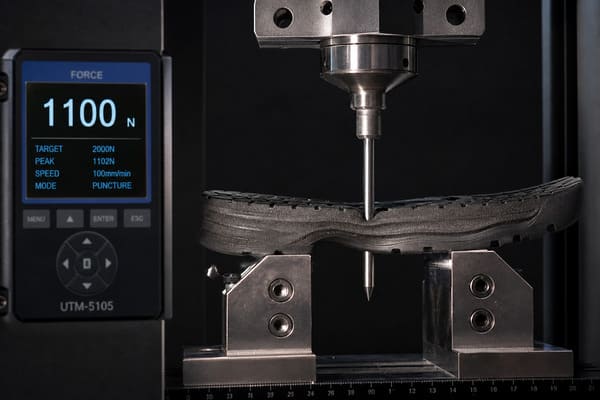
I started on the factory floor. I watched midsoles get tested one by one. I’ve seen batches pass at room temperature and fail in cold conditioning. Most buyers I talk to today still can’t tell me what force threshold their current supplier tests to. That’s a problem I want to fix — starting with what actually happens inside that shoe before it reaches your warehouse.
What Standards Define Anti-Puncture Performance in Safety Shoes?
A buyer once sent me a product spec that said only "anti-puncture required." No standard. No classification. No force value. When I asked which market the shoes were for, he wasn’t sure.
EN ISO 20345 defines two levels of puncture resistance: P1 requires the nail to be stopped at a minimum of 1100N, and P2 applies the same force threshold with tighter penetration limits. ASTM F2413 sets a minimum resistance of 270 lbf, which is roughly 1200N. These standards are not interchangeable.
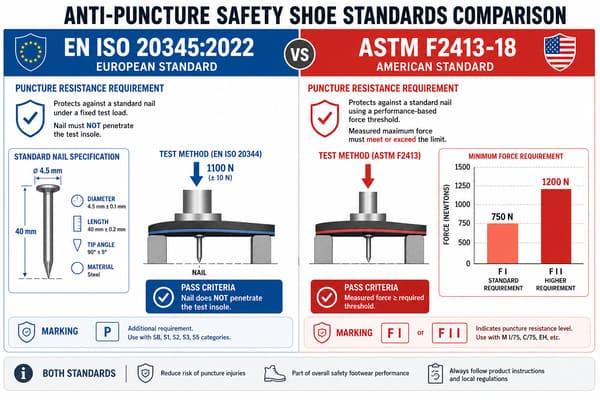
That conversation — where a buyer doesn’t know which standard their market requires — happens more than you’d think. And it creates a real compliance risk. A shoe certified to one standard cannot automatically be sold as compliant in a market that requires the other.
Why the Standard Matters Before You Approve a Sample
When a buyer skips this step, they often end up approving a sample that looks right but isn’t certifiable for their target market. By the time that becomes clear, the order is already in production.
Here’s a quick breakdown of what each standard actually covers:
| Standard | Region | Puncture Levels | Force Threshold | Test Assembly |
|---|---|---|---|---|
| EN ISO 20345 | Europe / Global | P1, P2 | 1100N minimum | Full shoe including insole |
| ASTM F2413 | USA / North America | PR (single level) | 270 lbf (~1200N) | Midsole only |
| AS/NZS 2210 | Australia / NZ | Aligned with EN | 1100N3 | Full shoe |
| GSO | Middle East | Aligned with EN | 1100N | Full shoe |
The force values look similar on paper, but the test method — especially what’s included in the assembly — makes a real difference to how a shoe is designed and what materials are chosen for the midsole. At Shoegan, we confirm the target standard with every buyer before we finalize a sample, because changing the midsole after sampling costs time and money that nobody wants to spend.
How Does a Nail Penetration Test Actually Work?
Most people who order anti-puncture shoes have never seen the test run. I remember the first time I watched a full test in our QC lab — the machine is quiet, the nail moves slowly, and the number on the display tells you everything.
A steel nail with a 4.5mm diameter conical tip is pressed through the midsole at a fixed speed of 10mm per minute4. The machine records the peak force before penetration. If the nail exits the other side before reaching the required force threshold, the sample fails.
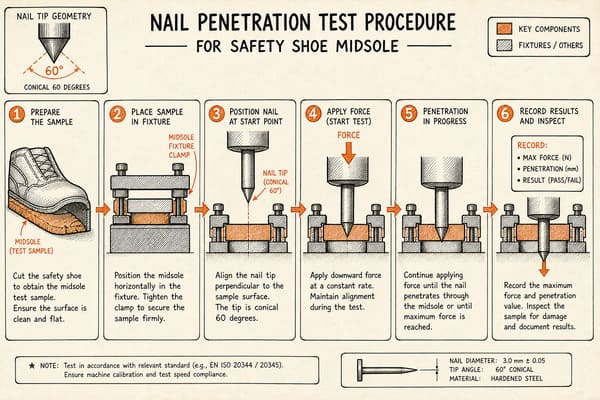
The test looks simple. But what the machine records is only part of the story. The condition of the sample before the test — temperature, humidity, whether it’s been pre-flexed — changes the result.
What Actually Happens During the Test
The nail used in EN ISO 20345 testing has a 60-degree conical tip and is 4.5mm in diameter. It’s pressed down at a constant, controlled rate. The test machine records continuous force data, not just a pass/fail signal.
One batch of composite midsole plates we tested last winter passed at room temperature without any issue. Then we ran the cold-conditioning round — samples held at -20°C before testing — and that same batch failed5. The plate had stiffened, and the failure mode changed. That kind of detail does not appear on a product spec sheet.
Here’s what the test process looks like step by step:
| Step | Action | Detail |
|---|---|---|
| 1 | Sample preparation | Cut midsole section, condition at standard or low temperature |
| 2 | Mount sample | Fix to test fixture, insole side up (EN ISO 20345) |
| 3 | Apply nail | 4.5mm diameter, 60° conical tip, centered on sample |
| 4 | Press at fixed speed | 10mm per minute, continuous force recording |
| 5 | Record result | Peak force before penetration, and whether nail exits |
| 6 | Compare to threshold | P1/P2 (EN) or 270 lbf (ASTM) |
One millimeter of variation in midsole thickness can push a product from passing to failing. That’s not a margin of error — that’s a quality control problem. At Shoegan, we test midsole thickness at multiple points across each production batch, because consistency across the midsole surface matters as much as the peak test result.
What Materials Are Used to Achieve Anti-Puncture Protection?
Three years ago, a client asked me to replace the steel midsoles in his safety shoes with Kevlar. His workers were complaining about weight. I understood why — a steel midsole alone can add around 180 grams per shoe6.
The three main materials used for anti-puncture midsoles are steel plates, aramid fiber (Kevlar) composites, and fiberglass composites. Each has different weight, flexibility, and chemical resistance characteristics. The right material depends on the job site conditions, not just the performance rating.
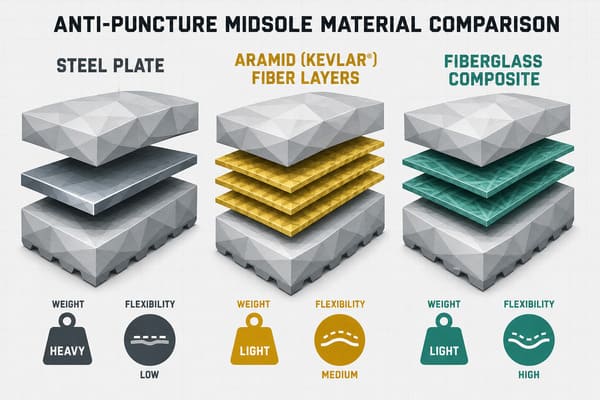
We switched that client to a 3-layer aramid fiber plate. The finished shoe came in 140 grams lighter per pair, and it still passed EN ISO 20345 P2. But I also told him the truth: aramid fiber plates can degrade faster in environments with heavy oil exposure7. For his specific site, we added a chemical-resistant lining over the midsole to address that risk.
Comparing the Three Main Anti-Puncture Midsole Materials
No single material is the right answer for every application. Here’s how the main options compare across the factors that matter most on a real job site:
| Material | Weight | Flexibility | Oil Resistance | Cold Performance | Cost |
|---|---|---|---|---|---|
| Steel plate | Heavy | Low | High | Stiffens in cold | Low |
| Aramid fiber (Kevlar) | Light | Medium-high | Medium | Stable | Medium-high |
| [Fiberglass composite | Medium | Medium | High | Stable | Medium](https://pmc.ncbi.nlm.nih.gov/articles/PMC9030624/)[^8] |
Steel plates are the most proven and lowest cost option. They pass puncture tests reliably and handle oil and chemical exposure well. The trade-off is weight and stiffness, which affects fatigue over a long shift. Aramid fiber gives you weight savings and reasonable flexibility, but it needs additional protection in heavily contaminated environments. Fiberglass composites sit in the middle — they’re a good choice when you need something lighter than steel without the chemical sensitivity of aramid.
When a buyer asks me which material to use, my first question is always: what does the worker actually stand on every day? The answer to that question drives the material selection more than any catalog comparison does.
How Do EN ISO 20345 and ASTM F2413 Differ in Puncture Resistance Testing?
Last year I worked with a buyer who was supplying PPE to both a French construction company and a Texas oil field operator. He assumed one certified shoe could cover both markets. I had to tell him directly — it can’t.
EN ISO 20345 tests the full shoe assembly including the insole8, and measures nail penetration depth after the midsole is passed. ASTM F2413 tests only the midsole and measures resistance force at a threshold of 270 lbf9. The nail dimensions used in each standard are also different.
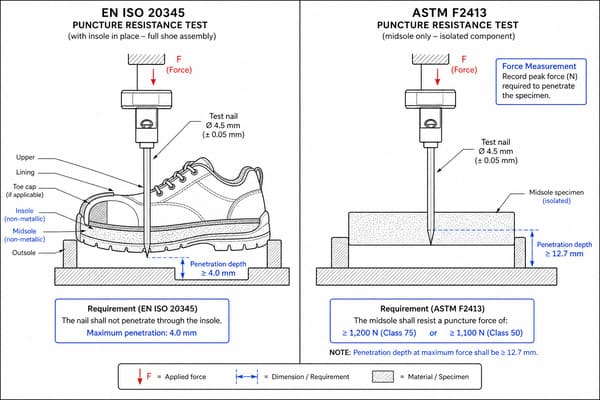
This buyer thought that because both standards had similar force thresholds, the certification would transfer. It doesn’t. The test method, the assembly, the nail geometry — these are all different. A shoe built to pass one standard may not pass the other without changes to the midsole construction.
Key Differences Between EN ISO 20345 and ASTM F2413 Puncture Testing
We ended up building two separate SKUs for that buyer — same upper design, different midsole configurations — to meet both certifications. That added about 12 days to his lead time. But it saved him from a compliance failure on two continents.
Here’s a direct comparison of the two standards across the points that affect midsole design:
| Test Factor | EN ISO 20345 | ASTM F2413 |
|---|---|---|
| Test assembly | Full shoe with insole in place | Midsole only |
| Force threshold | 1100N (P1 and P2) | 270 lbf (~1200N) |
| Penetration measurement | Yes — nail exit depth recorded | No — force only |
| Classification levels | P1, P2 | PR (single level) |
| Nail diameter | 4.5mm | Different specification |
| Temperature conditioning | Required (room and low temp) | Room temperature standard |
| Primary market | Europe, Middle East, Australia | USA, Canada |
The penetration measurement in EN ISO 20345 is the part most buyers don’t know about. It’s not enough for the nail to stop — the standard also limits how far the nail can travel into the shoe after initial penetration10. That puts more pressure on the midsole material to resist deformation, not just resist the initial force. ASTM F2413 only asks whether the force threshold was reached. These are different questions, and they lead to different midsole designs.
If you are sourcing for multiple markets, always confirm which certification is required in each market before finalizing your midsole specification. Changing it later costs time, and sometimes it means starting a new sample from scratch.
Conclusion
Anti-puncture testing is precise, standard-specific, and material-dependent. Trusting the label without knowing the test behind it is a compliance risk you don’t need to take. At Shoegan, we build safety shoes that are tested to the standard your market actually requires — EN ISO 20345, ASTM F2413, or both. Contact us at [email protected] or WhatsApp +8613008988018 to discuss your certification requirements.
-
"What Is the Puncture Resistance Rating in EN ISO 20345 …", https://protectyourfootsafety.com/what-is-the-puncture-resistance-rating-in-en-iso-20345/. EN ISO 20345 specifies performance requirements for safety footwear, including a minimum puncture resistance of 1100 N for the P1 and P2 classifications, as documented by standards bodies such as the European Committee for Standardization (CEN). Evidence role: definition; source type: institution. Supports: That EN ISO 20345 sets a minimum puncture resistance force of 1100N for protective footwear midsoles.. Scope note: The exact clause wording should be verified against the current edition of the standard, as revisions may alter specific thresholds or test conditions. ↩
-
"ASTM F2413-11 Performance Requirements for Protective Footwear", https://facilities.uw.edu/partner-resources/files/media/performance-requirements-for-protective-footwear.pdf. ASTM F2413, the Standard Specification for Performance Requirements for Protective (Safety) Toe Cap Footwear, specifies a minimum puncture resistance of 270 lbf under the PR designation, as published by ASTM International. Evidence role: definition; source type: institution. Supports: That ASTM F2413 mandates a minimum puncture resistance force of 270 lbf for compliant safety footwear.. Scope note: The conversion of 270 lbf to approximately 1200 N is a mathematical approximation; the standard itself states the requirement in imperial units. ↩
-
"What Are the Steps to Sourcing Safety Shoes from China …", https://protectyourfootsafety.com/what-are-the-steps-to-sourcing-safety-shoes-from-china/. AS/NZS 2210, published by Standards Australia and Standards New Zealand, sets performance requirements for occupational protective footwear including puncture resistance; the standard has been developed in alignment with the ISO 20345 framework, as indicated by Safe Work Australia guidance documents. Evidence role: general_support; source type: government. Supports: That AS/NZS 2210 aligns with EN ISO 20345 in its puncture resistance requirements and applies a 1100 N force threshold.. Scope note: Alignment does not necessarily mean identical clause-for-clause equivalence; specific test method differences may exist and should be confirmed with the current edition of AS/NZS 2210. ↩
-
"European Standards: Safety Shoes", https://lupos-safety.com/en-gb/useful-information/european-standards. ISO 20344, which defines the test methods referenced by EN ISO 20345, specifies that puncture resistance testing shall use a nail with a 4.5 mm diameter and a 60° conical tip, applied at a constant speed of 10 mm/min, with the peak force recorded prior to penetration. Evidence role: mechanism; source type: institution. Supports: That the puncture resistance test method specifies a 4.5 mm diameter nail with a conical tip applied at a crosshead speed of 10 mm/min.. Scope note: Specific clause numbers should be confirmed against the current edition of ISO 20344, as procedural details may differ across revisions. ↩
-
"Personal protective equipment — Test methods for footwear", https://www.iso.org/obp/ui/en/#!iso:std:73221:en. EN ISO 20345 mandates temperature conditioning as part of the puncture resistance test protocol, including exposure to low temperatures intended to simulate cold working environments, with specific conditioning parameters defined in ISO 20344. Evidence role: mechanism; source type: institution. Supports: That EN ISO 20345 / ISO 20344 requires puncture resistance samples to be conditioned at low temperature (typically -20°C) prior to testing.. Scope note: The exact conditioning temperature and duration should be verified in the current edition of ISO 20344, as these parameters may be subject to amendment. ↩
-
"How Flexible Is a Kevlar Anti-Puncture Midsole Compared to Steel …", https://protectyourfootsafety.com/how-flexible-is-a-kevlar-anti-puncture-midsole-compared-to-steel/. Research on ergonomic and biomechanical aspects of safety footwear has documented that steel midsoles and toe caps contribute significantly to shoe mass, with midsole weight varying by thickness and steel grade; specific values depend on midsole dimensions and alloy composition. Evidence role: general_support; source type: research. Supports: That steel anti-puncture midsoles contribute meaningfully to the overall weight of safety footwear, with typical values in the range cited.. Scope note: The 180 g figure is an industry approximation; published studies typically report total shoe mass rather than isolated midsole component weight. ↩
-
"para-Aramid Fibrils – Silica, Some Silicates, Coal Dust … – NCBI", https://www.ncbi.nlm.nih.gov/books/NBK410034/. Materials science literature on para-aramid fibers, including those marketed under the trade name Kevlar, indicates that while these fibers exhibit high tensile strength and cut resistance, their resistance to petroleum-based chemicals and organic solvents is more limited compared to steel or certain composite materials. Evidence role: mechanism; source type: research. Supports: That aramid fibers exhibit reduced durability or performance when exposed to petroleum-based oils and hydrocarbon contaminants.. Scope note: Degradation rates are highly dependent on fiber weave, coating treatments, and specific chemical composition; generalized statements may not apply uniformly to all aramid midsole constructions. ↩
-
"What Is the Puncture Resistance Rating in EN ISO 20345? – Shoegan", https://protectyourfootsafety.com/what-is-the-puncture-resistance-rating-in-en-iso-20345/. ISO 20344 specifies that puncture resistance tests under the EN ISO 20345 framework are conducted on the complete shoe assembly with the insole in place, meaning the insole contributes to the measured resistance and must be considered in midsole design. Evidence role: definition; source type: institution. Supports: That EN ISO 20345 / ISO 20344 specifies that the puncture resistance test be conducted with the insole in situ as part of the full shoe assembly.. Scope note: The procedural details should be confirmed against the current edition of ISO 20344, as assembly configuration requirements are subject to revision. ↩
-
"ASTM F2413-11 Performance Requirements for Protective Footwear", https://facilities.uw.edu/partner-resources/files/media/performance-requirements-for-protective-footwear.pdf. ASTM F2413 specifies that puncture resistance testing is performed on the midsole alone, with the test measuring the force required to penetrate the midsole material at a minimum threshold of 270 lbf, as published by ASTM International. Evidence role: definition; source type: institution. Supports: That ASTM F2413 evaluates puncture resistance by testing the midsole component separately, without including the insole in the test assembly.. Scope note: The precise assembly configuration and any permitted variations should be verified in the current edition of ASTM F2413. ↩
-
"DIN EN ISO 20345 standard: changes in 2022", https://www.uvex-safety.com/blog/din-en-iso-20345-changes-in-2022/. ISO 20344 specifies that the puncture resistance evaluation under EN ISO 20345 includes both a minimum force threshold and a maximum permissible penetration depth, requiring the midsole to resist deformation beyond a defined limit after the nail initially contacts the assembly. Evidence role: definition; source type: institution. Supports: That EN ISO 20345 / ISO 20344 specifies not only a minimum resistance force but also limits on the depth of nail penetration into the shoe assembly.. Scope note: The exact penetration depth limits and how they differ between P1 and P2 classifications should be verified against the current edition of ISO 20344. ↩