Most buyers don’t realize this until it’s too late: the dispute didn’t start at delivery. It started weeks before production even began.
Handling safety shoe returns and quality claims with a Chinese supplier comes down to one thing: written agreements made before production starts. Clear specs, defined inspection rights, and a tiered remedy policy — agreed in advance — resolve most disputes before they become disputes.
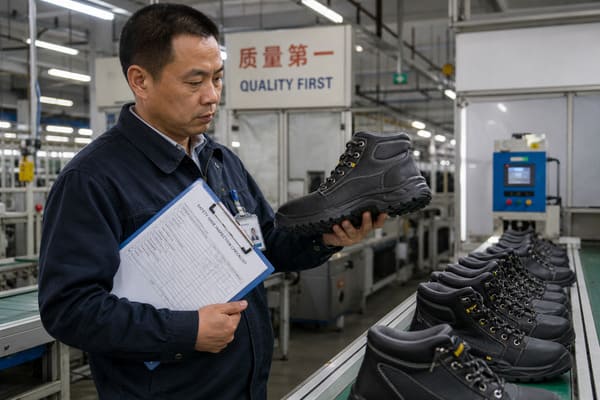
I’ve been in this industry for over 20 years. I started on the factory floor, and I’ve personally handled hundreds of production orders. The honest truth is this: 80% of the quality disputes I’ve seen were not caused by a bad supplier1. They were caused by a broken process — missing specs, skipped inspections, and assumptions that nobody wrote down. In this article, I want to show you what actually happens on the supplier’s side when a claim comes in, and what a manufacturer who takes quality seriously actually does about it.
What Are the Most Common Quality Issues in Safety Shoe Orders?
A client came to me two years ago — a PPE distributor from the Netherlands. He had just received 800 pairs of steel toe shoes from another supplier, and 130 pairs had sole delamination, with 40 pairs failing the EN ISO 20345 200-joule toe cap test2 at his local lab. He was furious, and honestly, he had every right to be.
The three most common quality issues in safety shoe orders are sole delamination, certification failures, and size inconsistency across batch runs. Each one is detectable before the container leaves the factory — with the right inspection process in place.
When I looked at that situation, the root cause was clear across all three problems.
Sole Delamination: The Most Common Physical Defect
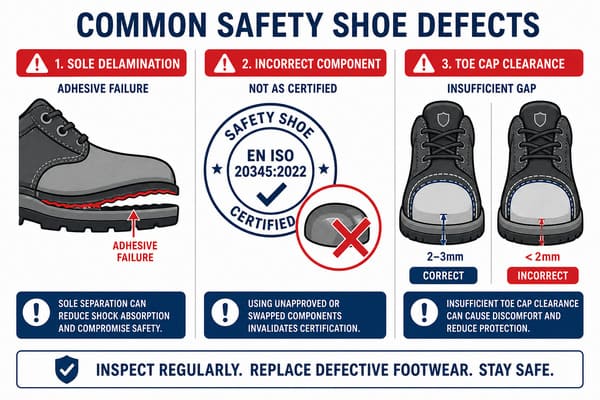
Sole delamination is the single most common physical defect I hear about. In almost every case, it comes down to one of two things: the wrong adhesive, or the vulcanization oven temperature dropping below spec during a night shift3 when supervision is lighter. In that Netherlands case, a 10-degree temperature drop that nobody caught caused 130 pairs to fail.
Certification Failures: The $0.30 Decision That Cost €12,000
The supplier in that order had EN ISO 20345 certification — but it was certified on a specific SKU with a specific toe cap. They swapped the toe cap supplier mid-order to cut costs by $0.30 per pair. That $0.30 saving cost the buyer €12,000 in failed goods. Certifications are tied to specific materials and components. Changing one component without re-testing invalidates the certification entirely4.
Size Inconsistency Across Batch Runs
This one is less dramatic, but very real. In orders above 500 pairs with multiple size runs, I’ve seen a EU42 from batch one measure 2–3mm shorter than a EU42 from batch two5. For a buyer selling into a regulated workwear program, that difference is a rejection. The table below shows where these defects typically come from and how they can be caught.
| Defect Type | Root Cause | Detection Method |
|---|---|---|
| Sole delamination | Wrong adhesive / temperature variance | Pre-shipment pull test |
| Certification failure | Component substitution mid-order | Material confirmation sheet + lab test |
| Size inconsistency | Multi-batch production without calibration | In-line QC measurement checks |
Every one of these issues is detectable before the container leaves the factory. A $300 pre-shipment inspection would have caught all three. Skipping it to save money is the most expensive decision a buyer can make.
How Do You File a Quality Claim with a Chinese Safety Shoe Supplier?
I tell every new client the same thing before we sign anything: a claim process that isn’t written into the contract before production starts is not a process — it’s an argument waiting to happen.
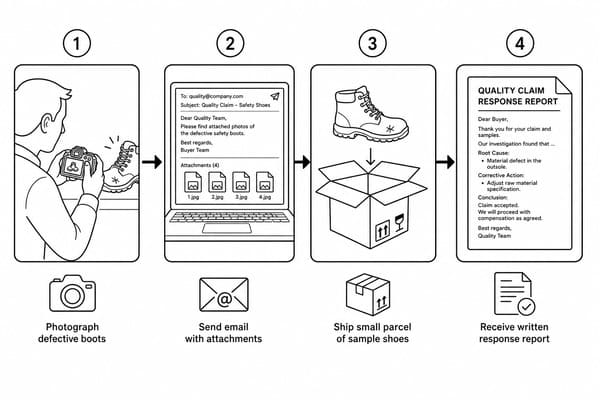
To file a quality claim with a Chinese safety shoe supplier, submit a written notice within 15 days of delivery, with photos, batch numbers, and a defect count. Request a root cause response within 7 business days. A credible supplier will ask for 5–10 sample pairs — not the full shipment.
Here’s what I’ve seen go wrong. A buyer in Australia received 600 pairs, found visible stitching defects on about 50 pairs, and waited 6 weeks before contacting the supplier. By that point, some pairs had already been sold. The supplier’s position was: "How do we know this happened before use?" Nobody was lying. But nobody had agreed on the rules beforehand either. The dispute went nowhere.
What a Working Claim Process Actually Looks Like
Here is what I follow on my side at Shoegan, and what I recommend every buyer write into their purchase agreement before production starts.
Timeline: Claims must come in within 15 days of confirmed delivery. After that, telling the difference between a manufacturing defect and wear damage becomes nearly impossible.
Evidence standard: Photos and video of defective units, the batch or lot number from the box label, and a clear defect count — for example, "47 defective pairs out of 600 received."
Sample return: I don’t ask for the full shipment back. I ask for 5–10 defective pairs sent by courier. That is enough to identify the root cause. Returning 600 pairs across the ocean costs more than the goods are worth in most cases.
Response time: At Shoegan, I commit to a written response within 7 business days of receiving the physical samples — not a vague promise to "look into it," but an actual root cause finding.
| Claim Step | Buyer Action | Supplier Action |
|---|---|---|
| Step 1: Notice | Send written claim within 15 days of delivery | Acknowledge receipt within 48 hours |
| Step 2: Evidence | Submit photos, batch number, defect count | Review documentation |
| Step 3: Samples | Ship 5–10 defective pairs by courier | Conduct physical inspection |
| Step 4: Resolution | Confirm remedy agreement | Issue root cause report within 7 business days |
A serious manufacturer doesn’t run from claims. I want to know what went wrong, because the same defect that affected your order could affect the next one. When a buyer sends me a clear, documented claim, it makes my factory better.
What Should a Return Policy Look Like When Buying Safety Shoes from China?
Let me be straightforward about something most suppliers won’t say directly: full returns on a B2B factory order from China are almost never the right solution — for either side.
A realistic return policy for safety shoes ordered from China should use a tiered remedy system: credit or replacement units for low defect rates, partial replacement shipments for mid-range defect rates, and full re-production at supplier cost for any critical safety failure. Full return freight rarely makes financial sense.
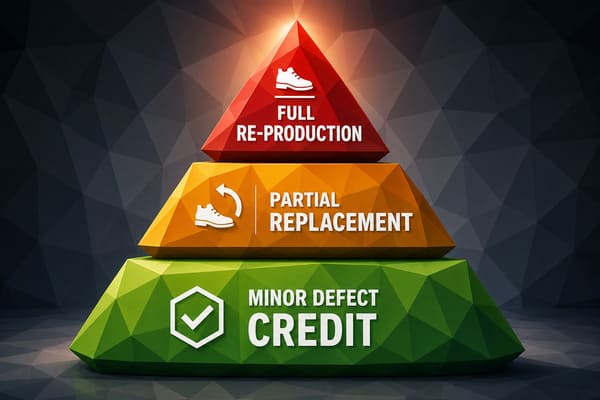
I had a client once who wanted to return 400 pairs over a 4% defect rate. The shipping cost alone would have been $1,800. The defective pairs totaled about 16 pairs. The math didn’t work. What actually made sense — and what we agreed on — was a replacement shipment of 20 pairs included in his next order at no charge. Problem solved in 3 weeks, no freight waste, no relationship damage.
A Tiered Remedy System That Actually Works
The table below shows the framework I recommend building into every purchase contract before production starts.
| Defect Rate | Category | Recommended Remedy |
|---|---|---|
| Below 3% | AQL 2.5 zone — minor | Credit on next order, or replacement units in next shipment |
| 3% – 10% | Moderate | Partial replacement shipment within 30 days + root cause report |
| Critical safety failure | Toe cap impact / anti-puncture test failure | Full re-production at supplier’s cost, no negotiation |
| Warranty void | Misuse, UV damage, unauthorized modification | No claim accepted |
The critical safety failure tier is non-negotiable for me personally. A shoe that fails a safety test is not a shoe. Any supplier who disagrees with that is telling you something important about how they operate.
Any supplier who offers "no claims, no returns" after shipment is also telling you something important. But a buyer who expects a full refund and free return freight on a 500-pair OEM order is being unrealistic. The right answer is always somewhere in the middle — and the time to agree on where that middle is, is before production starts, not after the container has already left port.
How Can You Prevent Quality Disputes Before They Happen?
This is the part I care about most, because prevention is where I spend the most energy with every new client. And this is also the part where I’ve personally learned the hardest lessons.
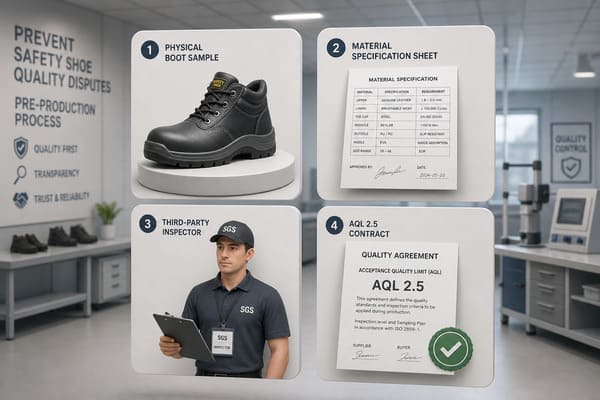
Quality disputes are almost always prevented at the pre-production stage — not at delivery. The tools that work are pre-production sample approval, a signed material confirmation sheet, third-party pre-shipment inspection, and AQL 2.5 written into the contract.
Early in my career, I was managing production for a factory that shipped 1,200 pairs to a buyer in the Middle East. The buyer had asked for "oil-resistant outsoles." We used a nitrile rubber compound that met our internal standard for oil resistance6. When the shoes arrived, the buyer’s client — a petrochemical plant — tested them against a specific ASTM standard we had never discussed. They failed. The order was rejected. No one was lying. No one was cheating. But no one had written down exactly what "oil-resistant" meant. That experience shaped how I run every order today.
The Four-Part Prevention System I Use at Shoegan
Pre-production sample approval is the first step. Before we cut a single piece of material for a full order, the buyer receives and approves a physical sample. That sample is photographed, labeled, and kept in our QC room. It becomes the production benchmark. If the finished goods don’t match it, they don’t ship.
Material confirmation sheet is the second step. For every order, we document the outsole compound grade, toe cap specification, upper material weight and finish, and lining type. This sheet is signed by both sides. It’s only one page, but it has prevented more disputes than any contract clause I’ve ever written.
Third-party pre-shipment inspection is the third step. I encourage every buyer — especially first-time clients — to book SGS, Bureau Veritas, or TÜV for a pre-shipment check7. It costs around $250–$400. Buyers who use third-party inspection have a dispute rate close to zero. The ones who skip it to save money are the ones calling me three weeks after delivery with a problem.
AQL 2.5 in writing is the fourth step. AQL 2.5 for major defects is the accepted industry standard8. It means roughly 1.5% of units can have major defects before the shipment is rejected. This number should be in the contract — not assumed.
| Prevention Tool | What It Does | Cost to Buyer |
|---|---|---|
| Pre-production sample approval | Sets the physical production benchmark | Time only |
| Material confirmation sheet | Documents every material spec, signed by both sides | Time only |
| Third-party pre-shipment inspection | Independent verification before shipment | $250–$400 |
| AQL 2.5 written into contract | Defines acceptable defect rate legally | Time only |
I have never had a serious dispute with a buyer who followed this process. Every dispute I’ve seen — on both sides — started with an assumption that nobody wrote down. The gap between what the buyer imagined and what the supplier understood is exactly where quality claims are born. Close that gap before production, and you almost never need to have the returns conversation at all.
Conclusion
Quality disputes in safety shoe orders are almost always preventable. Written specs, pre-production approvals, and a clear remedy policy — agreed before production — eliminate most problems before they start. At Shoegan, we build this process into every order from day one. If you’re looking for a mid-to-high end safety shoe manufacturer who takes quality accountability seriously, contact us at [email protected] or WhatsApp +8613008988018 — we’re ready to show you how we work.
-
"Unsafe and Unregulated Chinese Consumer Goods: Challenges in …", https://www.uscc.gov/sites/default/files/2024-11/Chapter_4–Unsafe_and_Unregulated_Chinese_Consumer_Goods.pdf. Research on quality management in global supply chains consistently identifies incomplete product specifications, inadequate pre-production alignment, and absent inspection protocols as systemic contributors to nonconformance, often outweighing deliberate supplier noncompliance as a root cause. Evidence role: general_support; source type: research. Supports: That a significant share of manufacturing quality failures in international sourcing are attributable to specification gaps and process breakdowns rather than supplier bad faith. Scope note: The specific 80% proportion cited reflects the author’s personal case history; no peer-reviewed study was identified that quantifies this ratio specifically for Chinese safety footwear exports. ↩
-
"How Do You Start a Private Label Safety Shoe Brand? – Shoegan …", https://protectyourfootsafety.com/how-do-you-start-a-private-label-safety-shoe-brand/. EN ISO 20345 (Personal protective equipment — Safety footwear) stipulates that toe caps must withstand an impact energy of 200 joules, as defined by the International Organization for Standardization. Evidence role: definition; source type: institution. Supports: The EN ISO 20345 standard specifies a 200-joule impact resistance requirement for safety footwear toe caps. Scope note: Readers should consult the current edition of the standard directly, as technical requirements may be revised between publication cycles. ↩
-
"Optimization of the Rubber Formulation for Footwear … – PMC", https://pmc.ncbi.nlm.nih.gov/articles/PMC7563865/. Materials science literature on rubber vulcanization documents that cure temperature directly governs crosslink density; under-cure resulting from temperature deviations is associated with reduced interfacial adhesion strength and increased risk of delamination in bonded rubber-to-substrate assemblies. Evidence role: mechanism; source type: research. Supports: That deviations from prescribed vulcanization temperatures negatively affect adhesive bond strength and contribute to sole delamination in footwear. Scope note: Published studies address vulcanization parameters in general rubber manufacturing contexts; peer-reviewed research focused specifically on night-shift supervision as a causal variable in footwear sole delamination is not readily available. ↩
-
"DIN EN ISO 20345 standard: changes in 2022", https://www.uvex-safety.com/blog/din-en-iso-20345-changes-in-2022/. Under EU PPE Regulation 2016/425 and associated conformity assessment procedures, manufacturers are required to notify their notified body of any changes to approved product designs or materials; undisclosed substitutions that affect safety-relevant characteristics may render the existing CE certification invalid. Evidence role: mechanism; source type: government. Supports: That substituting certified components in PPE footwear without re-testing invalidates the existing certification. Scope note: Specific procedural consequences vary by notified body and the materiality of the change; not all component substitutions automatically trigger full re-certification under every conformity assessment route. ↩
-
"Shoe size", https://en.wikipedia.org/wiki/Shoe_size. ISO 9407 (Shoe sizes — Mondopoint system of sizing and marking) and related footwear dimensional standards establish reference measurements for shoe sizing; dimensional deviations across production batches that exceed permissible tolerances represent a measurable nonconformance in regulated workwear procurement contexts. Evidence role: general_support; source type: institution. Supports: That footwear manufacturing standards define dimensional tolerances for sizing, and that variance beyond these tolerances constitutes a quality nonconformance. Scope note: The cited 2–3mm figure reflects the author’s field observation; published tolerance limits vary by standard and product category, and no industry-wide survey of batch-to-batch size variance in safety footwear was identified. ↩
-
"Effects of Epoxidised Natural Rubber on the Oil Resistance Property of …", https://www.researchgate.net/publication/349866612_Effects_of_Epoxidised_Natural_Rubber_on_the_Oil_Resistance_Property_of_NBRENR_Blends_used_for_Safety_Footwear_Application. Nitrile butadiene rubber (NBR) is documented in polymer science literature for its resistance to petroleum-based oils and fuels, properties attributable to its acrylonitrile content; it is commonly specified in industrial footwear outsole formulations requiring oil resistance. Evidence role: mechanism; source type: research. Supports: That nitrile (NBR) rubber exhibits oil-resistant properties relevant to safety footwear outsole applications. Scope note: Oil resistance performance of NBR varies with acrylonitrile content, compound formulation, and the specific oils or chemicals involved; compliance with a formal test standard such as ASTM or EN ISO requires testing of the specific compound under defined conditions, not reliance on material class alone. ↩
-
"How Do You Choose a Safety Shoe Manufacturer in China …", https://protectyourfootsafety.com/how-do-you-choose-a-safety-shoe-manufacturer-in-china/. SGS, Bureau Veritas, and TÜV SÜD are internationally recognized conformity assessment organizations accredited under ISO/IEC 17020 or ISO/IEC 17025, with operations throughout China and documented testing scope covering personal protective equipment including safety footwear. Evidence role: general_support; source type: institution. Supports: That SGS, Bureau Veritas, and TÜV SÜD are internationally accredited inspection and testing organizations operating in China with scope relevant to safety footwear. Scope note: Accreditation scope and local office capabilities vary by location within China; buyers should confirm that the specific branch engaged holds relevant accreditation for the applicable safety standard before engagement. ↩
-
"Acceptable quality limit", https://en.wikipedia.org/wiki/Acceptable_quality_limit. ISO 2859-1 (Sampling procedures for inspection by attributes) defines Acceptance Quality Limit (AQL) levels used in lot-by-lot inspection; AQL 2.5 corresponds to an acceptance threshold commonly applied to major defects in consumer and industrial goods procurement. Evidence role: definition; source type: institution. Supports: AQL 2.5 as a defined acceptance quality limit level under international sampling standards. Scope note: ISO 2859-1 does not mandate AQL 2.5 specifically for safety footwear; its application to this product category reflects common commercial practice rather than a sector-specific regulatory requirement. ↩