
Slip incidents at work cause thousands of injuries every year1. The label on your shoe says "SRC." But do you actually know what that means — and whether it protects your workers?
Slip resistance in safety shoes is tested by measuring the coefficient of friction between the outsole and a specific surface. The EN ISO 13287 method tests two surfaces: ceramic tile with soapy water (SRA) and steel plate with glycerol (SRB). A shoe that passes both earns the SRC rating under EN ISO 20345.
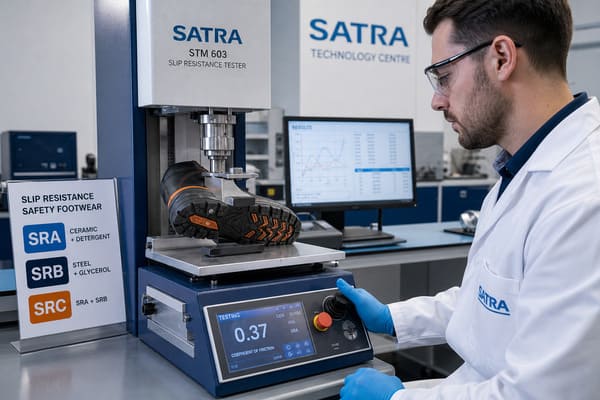
I have been in the safety shoe industry for over 20 years. I have seen buyers make the same mistake over and over — they trust the label and stop asking questions. This article breaks down what the tests actually measure, what the ratings actually mean, and what happens to grip after six months of real use. If you are sourcing safety shoes for industrial use, this is the article you need to read before placing your next order.
What Standards Are Used to Test Slip Resistance in Safety Shoes?
Most buyers treat certification as the finish line. In my experience, it is only the starting line.
EN ISO 20345 requires slip resistance testing for safety footwear sold in Europe2. The test follows EN ISO 13287, which measures friction on controlled surfaces in a lab3. The results are reproducible, but they only reflect performance on two specific surfaces — not the full range of floors found on real job sites.
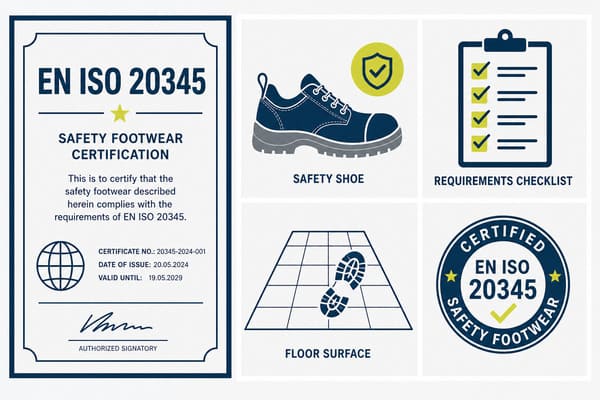
The standard is designed to be consistent and comparable. That is its strength. But that is also its limitation. A controlled lab surface is nothing like a food processing plant floor, a steel grating platform, or a wet concrete loading dock. The standard does not separate these situations. We have to do that ourselves, before production even starts.
I remember a client from the Middle East who came to us in 2022. He had already ordered 2,000 pairs from another supplier. The shoes passed EN ISO 20345. But within three months, his client — a food processing plant — reported six slip incidents on wet ceramic tile floors. No serious injuries, but the buyer cancelled the next order immediately. That supplier lost a $180,000 contract because they never asked one simple question: what floor surface do your workers actually stand on?
When I take on a new client, that is always my first question. The standard gives you a baseline. Your client’s actual floor gives you the real requirement. These two things are often very different.
| Floor Type | Common Contaminant | Standard Coverage |
|---|---|---|
| Ceramic tile | Soapy water | SRA — covered |
| Steel plate | Glycerol / oil | SRB — covered |
| Wet rubber mat | Water, food residue | Not covered |
| Wet concrete | Water, mud | Not covered |
| Steel grating | Machine oil | Partially covered |
Ceramic tile with soapy water is a completely different problem from steel grating with machine oil. The standard does not separate these two situations. We have to do that ourselves, before production even starts. If your supplier is not asking about your actual floor surface before recommending a product, that is a serious gap in their process.
What Do SRA, SRB, and SRC Mean on Safety Shoe Labels?
SRC looks like the best rating. And it is — on paper. But most buyers miss what is behind those three letters.
SRA means the shoe passed a friction test on ceramic tile with soapy water. SRB means it passed on a steel plate with glycerol. SRC means the shoe passed both tests. Under EN ISO 20345, SRC is the highest slip resistance classification, but it still only covers two specific surface-contaminant combinations.
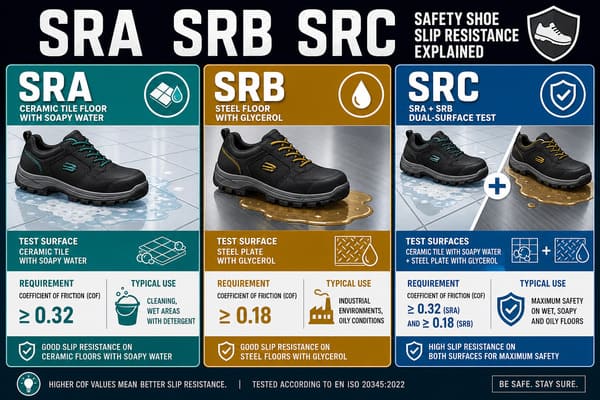
The SRC label is useful. But it does not tell you the shoe will perform on every surface in your facility. I had a client in Germany — a PPE distributor — who was selling SRC-rated shoes to food processing facilities. His end users started reporting slips on wet rubber conveyor mats. He called me frustrated, thinking the certification was wrong. It was not. The shoe simply was not designed for that surface. The SRC label told him the shoe passed two specific tests. Nobody told him those two tests did not cover rubber mats.
We spent two weeks back and forth, testing three different outsole compounds on rubber mat samples he sent to us. The third compound — a softer nitrile blend with a wider tread channel — reduced the slip rate to near zero in his facility’s own internal test. He reordered 1,500 pairs within the month.
Here is how the three ratings compare in practical terms:
| Rating | Test Surface | Contaminant | Minimum CoF Required |
|---|---|---|---|
| SRA | Ceramic tile | Soapy water (sodium lauryl sulfate) | ≥ 0.32 (forward), ≥ 0.18 (sideways) |
| SRB | Steel plate | Glycerol | ≥ 0.13 (forward), ≥ 0.13 (sideways) |
| SRC | Both above | Both above | Must pass both SRA and SRB |
The lesson is simple: match the test surface in the certification to the actual surface in the facility. If they do not match, the SRC label means very little in practice. Always ask your supplier which specific floor environment a shoe has been validated for — not just which certification it carries.
How Does Outsole Material Affect Slip Resistance Performance?
The outsole is where slip resistance is actually built. Not in the testing room. Not on the label.
Outsole material directly determines grip because it controls two things: how much surface contact the rubber makes with the floor, and how quickly the tread channels evacuate liquid. Softer rubber compounds generally provide better wet grip4. Wider, deeper tread channels reduce hydroplaning on wet surfaces.
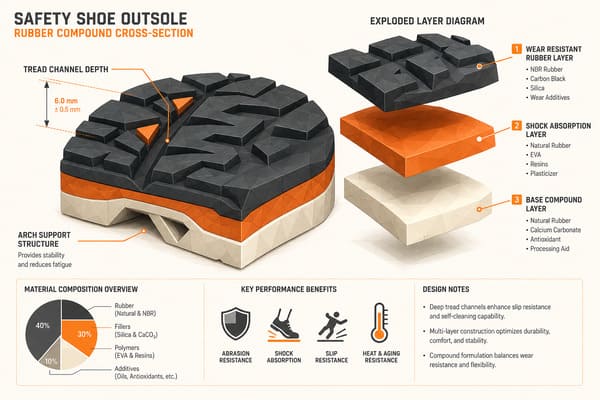
Most manufacturers chase hardness because harder soles last longer and cost less to produce. But hardness kills grip. A rubber compound rated Shore A 75 holds up for 18 months. A compound at Shore A 60 gives you around 30% better wet grip but wears faster5. That trade-off is real, and most buyers are never told about it.
What most buyers also never see is the tread channel design. The channels need to evacuate liquid fast enough to keep the rubber in contact with the floor. If the channels are too shallow, the shoe hydroplanes — exactly like a car tire in rain6. I once rejected an entire batch of outsole molds in our factory because the channel depth measured 0.3mm short of our internal specification. My QC team flagged it. Some people thought I was being too strict. But 0.3mm across 3,000 pairs means 3,000 pairs that underperform in wet conditions. I sent the molds back.
| Outsole Material | Wet Grip | Oil Resistance | Durability | Best Application |
|---|---|---|---|---|
| Pure natural rubber | High | Low | Moderate | Wet floors, general industry |
| Pure PU | Moderate | Moderate | High | Dry to mildly wet environments |
| Nitrile rubber blend | High | High | Moderate-High | Oil-exposed, wet, industrial floors |
| TPU | Low-Moderate | High | Very High | Dry conditions, abrasion-heavy use |
We use a nitrile rubber blend for most of our slip-resistant outsoles. Pure rubber gets brittle below -10°C and loses grip fast7. Pure PU performs well dry but drops significantly when wet8. Our blend sits at Shore A 62, which we arrived at after testing 11 different compound formulas over about eight months. That number did not come from a catalog. It came from worn soles that clients sent back to us, and from our own internal wear tests. The tread design and the compound formula work together. You cannot optimize one without considering the other.
How to Test Slip-Resistant Shoes?
The formal test is useful. But it only tells you half the story.
To test slip resistance in safety shoes, the standard method is EN ISO 13287, which measures the coefficient of friction on defined surfaces under controlled load and speed. For real-world validation, accelerated wear testing and field sample collection after 6 to 12 months of use provide far more accurate performance data.
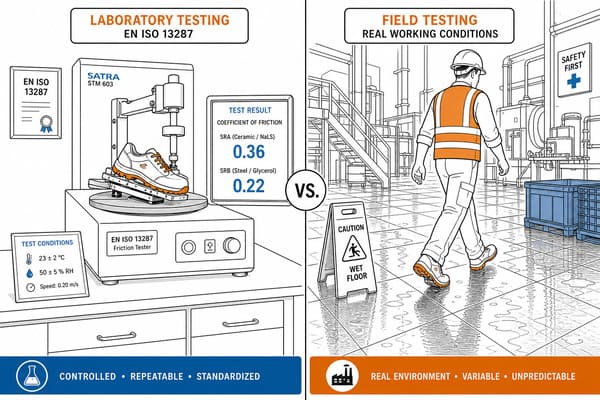
EN ISO 13287 is the method behind the SRA, SRB, and SRC ratings. It measures friction under controlled conditions — specific surface, specific contaminant, specific load. The results are reproducible and comparable across manufacturers. That is the value. But the test only captures one moment in the shoe’s life: day one, brand new, straight out of the box.
What it does not capture is what happens at month six. Tread depth on a new outsole is typically 4 to 6mm. After six months of daily use in a warehouse or factory, that can drop to 1.5mm9. At that depth, the channeling system that evacuates liquid is essentially gone. The coefficient of friction drops sharply — sometimes by 40% or more — but the shoe still looks fine from the outside. Workers keep wearing it. That is when accidents happen.
| Test Method | What It Measures | Limitation |
|---|---|---|
| EN ISO 13287 (lab) | CoF on two standard surfaces, new shoe | Day-one performance only |
| Accelerated wear test | CoF after simulated 6–12 months of use | Lab simulation, not real environment |
| Field sample collection | Real-world wear patterns and grip loss | Slower, requires client cooperation |
| In-house surface matching | Grip on client’s actual floor material | Only done by suppliers who ask the right questions |
In our factory, we run accelerated wear tests that simulate 12 months of use before a new style goes to market. We also ask clients to send back worn pairs after six months in the field. Most manufacturers test once, certify, and move on. We have collected over 200 worn pairs from clients across eight countries in the past four years. That data tells us more about real-world performance than any lab test. It is also how we improved our current outsole compound twice in three years — without changing the design, just the formula.
Conclusion
Slip resistance testing starts with certification but does not end there. The real answer comes from the floor surface, the outsole compound, and actual wear over time. At Shoegan, we build slip resistance into every compound decision, every tread spec, and every pair — because protection that fails at month six was never really protection at all. Contact us at [email protected] to discuss the right outsole solution for your specific job site conditions.
-
"Fast Facts- Traumatic Occupational Injuries | NIOSH", https://archive.cdc.gov/www_cdc_gov/niosh/injury/fastfacts.html. Government occupational safety agencies, including the U.S. Bureau of Labor Statistics and the UK Health and Safety Executive, report tens of thousands of non-fatal workplace injuries annually attributed to slips, trips, and falls on the same level, making this one of the leading categories of occupational injury. Evidence role: statistic; source type: government. Supports: Annual incidence of workplace injuries attributable to slips, trips, and falls. Scope note: Figures vary by country, industry sector, and reporting year; the article does not specify a jurisdiction or time period. ↩
-
"What Is the Puncture Resistance Rating in EN ISO 20345 …", https://protectyourfootsafety.com/what-is-the-puncture-resistance-rating-in-en-iso-20345/. EN ISO 20345 specifies basic and additional requirements for safety footwear used in professional environments, including mandatory slip resistance classification (SRA, SRB, or SRC) tested in accordance with EN ISO 13287; the standard applies to footwear marketed within the European Economic Area. Evidence role: definition; source type: institution. Supports: That EN ISO 20345 is the applicable European standard specifying slip resistance requirements for safety footwear. Scope note: The full text of the standard is available only through purchase from ISO or national standards bodies; secondary descriptions should be verified against the primary document. ↩
-
"What Questions Should You Ask a Safety Shoe Supplier …", https://protectyourfootsafety.com/what-questions-should-you-ask-a-safety-shoe-supplier/. EN ISO 13287 specifies a method for determining the slip resistance of footwear by measuring the dynamic coefficient of friction between the outsole and defined test surfaces (ceramic tile with sodium lauryl sulfate solution and steel plate with glycerol) under controlled load and velocity conditions. Evidence role: mechanism; source type: institution. Supports: That EN ISO 13287 defines the laboratory procedure for measuring the coefficient of friction between footwear outsoles and specified test surfaces. Scope note: The standard document itself is paywalled; descriptions from standards bodies or accredited testing laboratories provide the most reliable secondary characterization. ↩
-
"FRICTIONAL PROPERTIES OF RUBBER", https://nvlpubs.nist.gov/nistpubs/jres/28/jresv28n4p439_a1b.pdf. Tribological research on elastomeric materials demonstrates that softer rubber compounds (lower Shore A hardness) exhibit greater real contact area on rough or wet surfaces, which increases frictional force; this relationship is well-documented in studies of tire and footwear outsole materials. Evidence role: mechanism; source type: research. Supports: That lower Shore A hardness in rubber compounds correlates with higher coefficients of friction on wet surfaces. Scope note: The precise magnitude of grip improvement varies with compound formulation, surface texture, and contaminant type; the article’s claim of approximately 30% improvement at Shore A 60 versus 75 is specific to the manufacturer’s internal testing and is not directly supported by published literature. ↩
-
"Wet Grip Performance Evaluation Method of All-Steel Radial …", https://pmc.ncbi.nlm.nih.gov/articles/PMC12566693/. Materials science literature on rubber tribology confirms an inverse relationship between compound hardness and wet-surface friction, alongside a positive correlation between hardness and abrasion resistance, indicating that formulation choices involve inherent performance trade-offs. Evidence role: general_support; source type: research. Supports: That a trade-off exists between rubber hardness, wet grip performance, and abrasion resistance in outsole compounds. Scope note: The specific figures cited (30% grip improvement, 18-month versus faster wear) are the author’s proprietary data and are not independently verifiable from published sources. ↩
-
"HYDRODYNAMICS OF TIRE HYDROPLANING", https://ntrs.nasa.gov/api/citations/19660026826/downloads/19660026826.pdf. Research on footwear slip resistance identifies tread channel geometry as a critical factor in wet-surface grip, as insufficient channel depth reduces the rate of fluid evacuation from the contact zone, diminishing the real contact area between the outsole and floor surface in a manner analogous to tire hydroplaning. Evidence role: mechanism; source type: research. Supports: That inadequate tread channel depth impairs liquid evacuation and reduces contact friction on wet surfaces in footwear outsoles. Scope note: Direct experimental studies on footwear hydroplaning are less extensive than tire research; much of the supporting evidence is extrapolated from tire tribology and general fluid mechanics. ↩
-
"MECHANICAL PROPERTIES OF RUBBER", https://ptacts.uspto.gov/ptacts/public-informations/petitions/1549568/download-documents?artifactId=3VpxoVnWA80Bh0UwI-AzTz53LOpYdckLgYuLisWom2zGDJj3Qytl-nM. Polymer science literature documents that natural rubber undergoes significant increases in elastic modulus at low temperatures as it approaches its glass transition region, resulting in reduced real contact area with surfaces and diminished frictional performance; this behavior is well-characterized in studies of rubber tribology and cold-weather material performance. Evidence role: mechanism; source type: research. Supports: That natural rubber exhibits increased stiffness and reduced friction performance at temperatures below approximately -10°C. Scope note: The precise temperature threshold for grip loss depends on compound formulation and the presence of plasticizers or blending agents; -10°C is an approximate practical threshold rather than a universal material constant. ↩
-
"Development of a High Slip-resistant Footwear Outsole Using a Hybrid …", https://pmc.ncbi.nlm.nih.gov/articles/PMC4246531/. Comparative studies of footwear outsole materials report that polyurethane compounds, while offering high durability and moderate dry-surface friction, generally demonstrate lower coefficients of friction on wet or contaminated surfaces relative to natural or nitrile rubber blends, attributed to differences in surface energy and viscoelastic contact behavior. Evidence role: general_support; source type: research. Supports: That polyurethane outsoles exhibit lower wet-surface friction compared to rubber-based compounds. Scope note: Performance differences depend on specific PU formulation, surface texture, and contaminant; the article’s characterization reflects a general trend rather than a universal property of all PU compounds. ↩
-
"Evaluation of safety boots and their relationships with the foot structure …", https://pmc.ncbi.nlm.nih.gov/articles/PMC12487406/. Studies on occupational footwear wear document significant reductions in outsole tread depth over periods of sustained industrial use, with wear rates dependent on floor surface abrasiveness, worker gait, and outsole compound hardness; initial tread depths and residual depths after extended use vary across published investigations. Evidence role: statistic; source type: research. Supports: Typical tread depth wear rates for safety footwear outsoles under industrial use conditions. Scope note: The specific figures cited (4–6mm new, 1.5mm after six months) are the author’s field observations; published studies report a range of values depending on use conditions and are not directly comparable without controlling for the same variables. ↩