
The resistance range question sounds simple, but it trips up almost every first-time buyer I talk to. I’d say 7 out of 10 clients who come to me asking for "ESD shoes" don’t actually know what resistance number they need.
The correct ESD resistance range is 0.1 MΩ to 1000 MΩ1. Below 0.1 MΩ, the shoe becomes too conductive and turns the wearer into a current path2. Above 1000 MΩ, static charge has nowhere to go and keeps building up3 — which defeats the entire purpose of wearing ESD footwear.
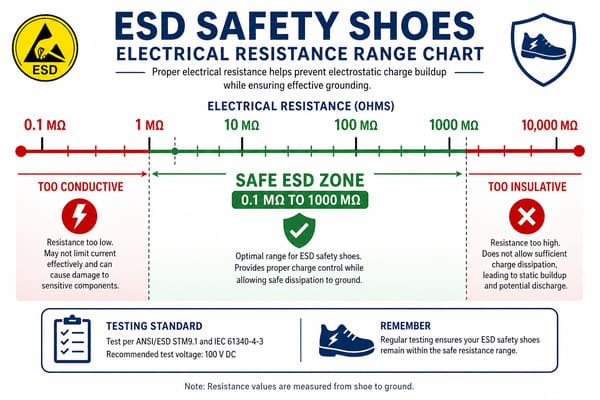
I once had a client from a PCB assembly factory in Shenzhen who had been using shoes labeled "anti-static" for two years. When we tested them, the resistance came back at over 2000 MΩ — completely outside the ESD range. Their workers were still accumulating static the entire time. The label said one thing. The numbers said another. That gap between labeling and real performance is exactly why this question matters, and why I want to walk through it properly here.
What Makes a Safety Shoe "ESD-Rated"?
"Anti-static" and "ESD-rated" are not the same thing, but the market treats them like they are. This difference is costing buyers real money and real protection.
An ESD-rated shoe is tested as a complete system — not just the outsole4. The resistance is measured through the full construction: insole, midsole, outsole, and any stitching or hardware that touches the foot-to-floor path. Every layer in that path must fall within the 0.1 MΩ to 1000 MΩ window.
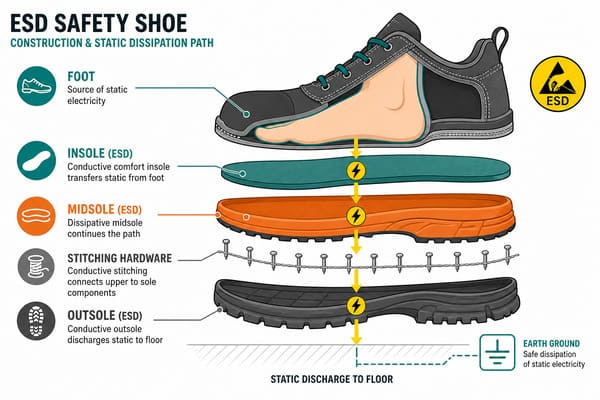
I’ve personally tested over 30 shoe samples from different suppliers over the years, and at least a third of them failed the resistance threshold despite carrying an "anti-static" label. One time, a client sent me a competitor’s sample to benchmark against. The outsole material was fine. But the factory had used a standard foam insole with a resistance over 10,000 MΩ. That single layer completely broke the dissipation path. The finished shoe looked right. Functionally, it was useless as an ESD product. We caught it in 20 minutes of bench testing.
Why the Full Construction Test Matters
Most buyers only ask about the outsole material. That is the wrong question. Here is a breakdown of what each construction layer contributes to the total resistance path:
| Construction Layer | Role in ESD Path | Common Failure Point |
|---|---|---|
| Outsole | Primary contact with floor | Wrong rubber compound, high-resistance filler |
| Midsole | Connects outsole to insole | Standard EVA foam breaks the path entirely |
| Insole | Contact point for foot | Most overlooked — often swapped post-production |
| Stitching / Hardware | Bridges between layers | Non-conductive thread kills the path silently |
Every layer must be specified, sourced, and tested together. At Shoegan, when we produce ESD shoes, we run resistance tests at each construction stage — not just on the finished pair. A shoe that passes at the outsole stage can still fail as a finished product. That is why system-level testing is non-negotiable, and why we document each test result as part of our quality record for every production batch.
How Do ESD Safety Shoes Actually Work?
A lot of buyers think the shoe does all the work. It doesn’t. If you believe the shoe alone solves your static problem, you may already have an issue you haven’t traced yet.
ESD shoes work by providing a controlled resistance path for static charge to travel from the wearer’s body to the floor5. The full chain is: body → shoe → floor → ground6. If any part of that chain is broken, the shoe cannot function — no matter how well it is made.
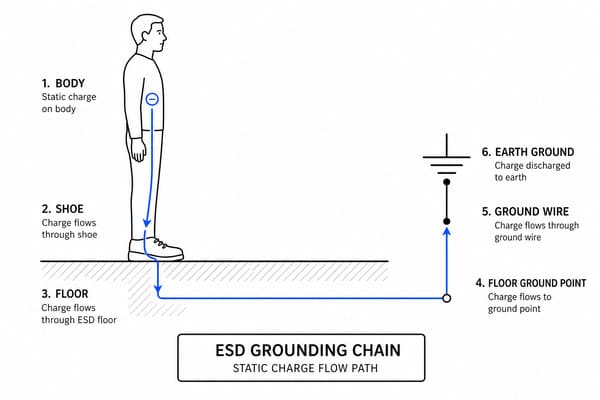
I learned this the hard way early in my career. A client came back to me saying his workers were still getting static shocks after switching to our ESD shoes. We tested the shoes — they were fine, resistance well within 0.1 to 1000 MΩ. Then we asked about the floor. Turns out they had just installed new vinyl flooring with a surface resistance above 10¹² Ω7. The shoes were working perfectly. The floor was the problem. That conversation changed how I onboard every new ESD client. I now always ask about the floor before we confirm the shoe spec.
The ESD System: What Each Part Must Do
Here is how to think about the full ESD control system in a workspace:
| System Component | Required Property | What Happens If It Fails |
|---|---|---|
| ESD Safety Shoe | 0.1 MΩ – 1000 MΩ resistance | Static stays in the body |
| Floor / Mat | ESD-rated surface resistance | Static has nowhere to travel to ground |
| Ground Connection | Properly bonded to earth | Static accumulates in the floor itself |
| Worker | No heavy insulating socks or insoles | Breaks the body-to-shoe contact path |
One detail that surprises many buyers: thick wool socks or aftermarket insoles can raise the total system resistance above the safe threshold8, even if the shoe itself is fully ESD-compliant. This is why we always recommend workers in ESD environments use thin, conductive or cotton socks — and never swap in standard cushioning insoles from another shoe.
What Are the Safety Standards for ESD Shoes?
The certification question comes up on almost every order I handle. And the answer is almost never simple, because it depends entirely on where the shoes are being used — not where they are made.
ESD footwear standards vary by region. EN ISO 20345 defines the 0.1 MΩ to 1000 MΩ range for European markets9. ASTM F2413 covers the US but focuses on electrical hazard insulation rather than static dissipation10. AS/NZS 2210 applies to Australia and New Zealand. The Middle East follows GSO requirements.
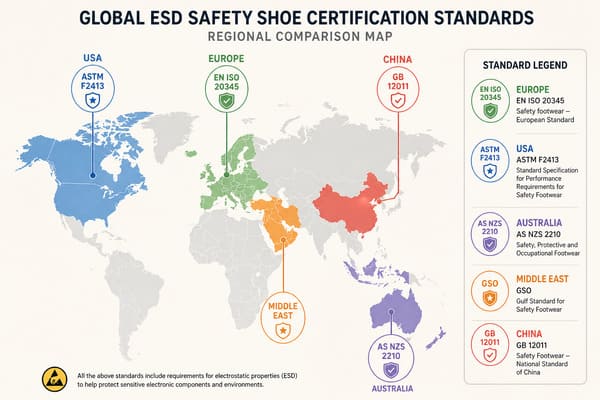
I had one client in Dubai who assumed his EN ISO 20345 certification would cover his Gulf market contracts. It didn’t. GSO has its own requirements, and the assumption almost cost him a major project. We caught it during pre-shipment documentation review and re-tested in time. One order, three different markets, three different certification paths.
Regional ESD Standard Comparison
Here is a quick reference for the standards I work with most often:
| Region | Standard | ESD Resistance Requirement | Notes |
|---|---|---|---|
| Europe | EN ISO 20345 | 0.1 MΩ – 1000 MΩ | Clearly defined ESD classification ("ESD" marking) |
| United States | ASTM F2413 | No direct ESD spec | Static dissipation governed by workplace/industry standards |
| Australia / NZ | AS/NZS 2210 | Follows similar range | Classification system differs from EN ISO |
| Middle East / Gulf | GSO | Country-specific requirements | Does not automatically accept EN ISO 20345 |
| China | GB 12011 | Defined resistance range | Required for domestic Chinese market sales |
At Shoegan, we hold certifications across EN ISO 20345, ASTM F2413, AS/NZS 2210, GSO, and GB 12011. When a client tells me which market they’re supplying, we confirm the right certification path before production starts — not after. Getting this wrong at the documentation stage is far more expensive than getting it right at the planning stage.
Are Electrical Hazard Shoes the Same as ESD Shoes?
This is the single most common mix-up I see in this industry, and it is a real safety risk — not just a spec error. Confusing these two categories has already cost some of my clients tens of thousands of dollars.
ESD shoes and electrical hazard (EH) shoes are engineered to do opposite things. ESD shoes let static charge out of the body by creating a low-resistance path to the floor. EH shoes block external electrical current from entering the body by providing high electrical insulation.11 Using one in place of the other is a serious hazard.
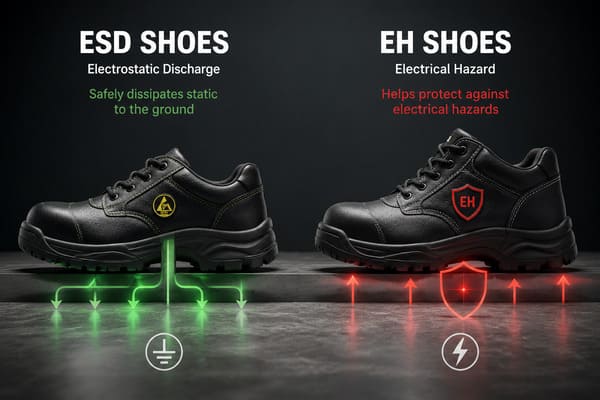
I had a client in an oil refinery in Malaysia who had been sourcing EH-rated shoes for his ESD workstations. His workers were fully insulated from the floor — which meant static had absolutely nowhere to go. For two years, sensitive components were being damaged at a rate they couldn’t explain. When they finally traced it back to footwear, the financial loss from faulty components was already in the tens of thousands of dollars.
ESD vs. EH: A Side-by-Side Breakdown
| Property | ESD Shoes | EH (Electrical Hazard) Shoes |
|---|---|---|
| Primary Function | Dissipate static charge from body to floor | Insulate wearer from external electrical current |
| Resistance Range | 0.1 MΩ – 1000 MΩ | Typically > 1 MΩ (designed to block, not conduct) |
| Risk if Used Wrong | Static damage to components or ignition hazard | Static builds up, no dissipation path to ground |
| Correct Environment | Electronics manufacturing, cleanrooms, explosive areas | Live electrical work, power generation, construction near live lines |
| Can They Combine? | Yes, but requires dual-material engineering and separate testing | Same — combination products exist, but tolerance is tight |
Some buyers do need both properties in a single shoe. These combination products exist, and we have made them at Shoegan. But the resistance tolerance window is very narrow, and the material selection is precise. It is not something you achieve by modifying a standard design. It requires purpose-built construction and dual certification testing from the start.
Conclusion
ESD shoes must fall between 0.1 MΩ and 1000 MΩ, be tested as a full system, meet the right regional standard, and never be confused with EH footwear. Every detail here is a safety decision. If you are sourcing ESD safety shoes for your team or your clients, Shoegan manufactures certified ESD footwear built to spec — contact us at [email protected] or WhatsApp +8613008988018.
-
"What Is the Difference Between ESD and Antistatic Safety Shoes …", https://protectyourfootsafety.com/what-is-the-difference-between-esd-and-antistatic-safety-shoes/. International standards such as EN ISO 20345:2011 define the electrical resistance range for ESD footwear, establishing the 0.1 to 1000 megohm window as the safe dissipation threshold. Evidence role: definition; source type: institution. Supports: the specific resistance range (0.1 MΩ to 1000 MΩ) required for ESD-rated footwear. ↩
-
"1910.333 – Selection and use of work practices. – OSHA", https://www.osha.gov/laws-regs/regulations/standardnumber/1910/1910.333. Safety standards establish the lower resistance boundary to prevent footwear from becoming excessively conductive, which could allow hazardous electrical current to pass through the wearer’s body in environments with electrical risk. Evidence role: mechanism; source type: institution. Supports: why resistance below 0.1 MΩ creates an unsafe conductive path for electrical current through the wearer. Scope note: This addresses the general principle; specific current thresholds depend on workplace voltage levels and would require context-specific electrical safety references. ↩
-
"What Is the Difference Between ESD and Antistatic Safety Shoes …", https://protectyourfootsafety.com/what-is-the-difference-between-esd-and-antistatic-safety-shoes/. Electrostatic discharge control principles indicate that resistance exceeding 1000 megohms significantly impedes charge dissipation, allowing static voltage to accumulate on personnel to levels that can damage sensitive electronics. Evidence role: mechanism; source type: research. Supports: why resistance above 1000 MΩ fails to adequately dissipate static charge. ↩
-
"[PDF] JSC-66552BASELINE.pdf – NASA Standards", https://standards.nasa.gov/sites/default/files/standards/JSC/Baseline/0/JSC-66552BASELINE.pdf. Footwear safety standards specify that ESD resistance measurements must be performed on the complete assembled shoe to verify the electrical path through all layers from foot to floor contact. Evidence role: general_support; source type: institution. Supports: that ESD footwear certification requires testing the complete assembled product rather than isolated components. ↩
-
"What Is the Difference Between ESD and Antistatic Safety Shoes …", https://protectyourfootsafety.com/what-is-the-difference-between-esd-and-antistatic-safety-shoes/. ESD control principles establish that specialized footwear dissipates static charge by maintaining electrical continuity between the wearer and a grounded surface through materials engineered to provide controlled resistance. Evidence role: mechanism; source type: research. Supports: the fundamental mechanism by which ESD footwear dissipates static charge through a controlled-resistance path. ↩
-
"Shoegan | Safety Shoes Manufacturer – Steel Toe, OEM …", https://protectyourfootsafety.com/. ESD control standards such as ANSI/ESD S20.20 specify that a complete grounding system must include personnel grounding through footwear in combination with ESD flooring or matting connected to electrical ground. Evidence role: general_support; source type: institution. Supports: that effective ESD protection requires a complete electrical path from personnel through footwear and flooring to ground. ↩
-
"Conductive Versus Static Dissipative Resilient Flooring", https://www.floorexpert.com/knowledge-base/conductive-versus-static-dissipative-resilient-flooring/. Standard commercial flooring materials, including conventional vinyl, typically function as electrical insulators with surface resistance values often exceeding 10¹² ohms, preventing effective static dissipation even when ESD footwear is used. Evidence role: general_support; source type: research. Supports: that conventional vinyl and other standard flooring materials typically exhibit surface resistance in the 10¹² ohm range or higher. Scope note: Exact resistance values vary by flooring composition, finish, and environmental conditions; specific product testing is needed for precise values. ↩
-
"Comfortable safety footwear: Types of insoles and accessories – GPI Shoes", https://gpi.shoes/comfortable-safety-footwear-types-of-insoles-and-accessories/. ESD control guidance indicates that insulating materials introduced between the foot and ESD footwear, including certain sock materials and aftermarket insoles, can significantly increase contact resistance and reduce the effectiveness of the grounding pathway. Evidence role: general_support; source type: research. Supports: that insulating materials worn with ESD footwear (such as thick socks or non-conductive insoles) can interrupt the electrical path and compromise static dissipation. ↩
-
"What Is the Difference Between ESD and Antistatic Safety Shoes …", https://protectyourfootsafety.com/what-is-the-difference-between-esd-and-antistatic-safety-shoes/. EN ISO 20345:2011, the European standard for safety footwear, defines the resistance requirements for electrostatic dissipative (ESD) footwear within the specified megohm range. Evidence role: definition; source type: institution. Supports: that EN ISO 20345 specifies the 0.1 to 1000 MΩ resistance range for ESD footwear classification. ↩
-
"What Are the Risks of Buying Safety Shoes from Unknown Suppliers …", https://protectyourfootsafety.com/what-are-the-risks-of-buying-safety-shoes-from-unknown-suppliers/. ASTM F2413 specifies performance requirements for protective footwear including electrical hazard resistance, while electrostatic dissipative properties in the US are typically governed by separate workplace-specific or industry standards. Evidence role: general_support; source type: institution. Supports: that ASTM F2413 primarily addresses electrical hazard insulation and does not include specific ESD resistance requirements. Scope note: This characterizes the standard’s scope; complete verification would require examining the full standard document and related ASTM standards for ESD footwear. ↩
-
"EH vs ESR vs ESD Work Footwear: What’s the Difference?", https://www.keenfootwear.com/blogs/keen-blog/eh-vs-esr-vs-esd-work-footwear-what-s-the-difference. Safety footwear standards distinguish between electrostatic dissipative (ESD) footwear, designed to prevent static accumulation through controlled conductivity, and electrical hazard (EH) footwear, designed to insulate wearers from electrical shock by maintaining high resistance to current flow. Evidence role: general_support; source type: institution. Supports: the opposing design objectives of ESD footwear (facilitating charge dissipation) versus electrical hazard footwear (providing electrical insulation). ↩
[…] Electrically insulating safety shoes work by creating a complete break in the electrical circuit between a live source and the ground. The sole must have a high enough resistance to prevent current from passing through the body. Under EN ISO 20345, Class I insulating shoes are tested at up to 15,000 volts, with leakage current …1 […]