
A client from the Middle East came to us with a real problem. Workers were complaining about foot pain. Shoes were deforming in 3 months. The cause was clear.
The shank is a rigid strip, usually 10–15 cm long, placed between the insole and outsole in the arch area of the shoe.1 It is the structural core of the shoe. It distributes load, maintains arch support, and prevents the shoe from bending or warping under weight.
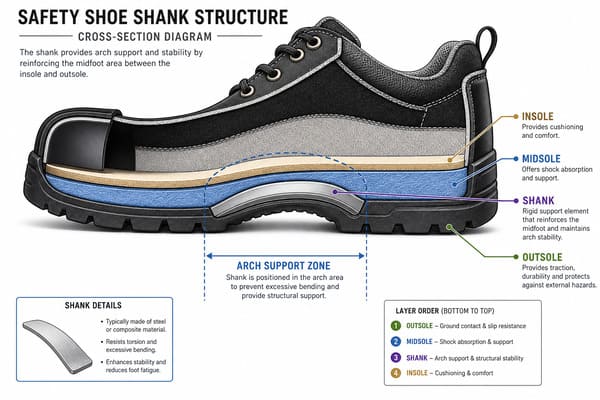
When I inspected the sample shoes that client brought, I found either no shank at all, or a thin plastic strip that provided almost no real support. Those shoes had passed basic EN ISO 20345 testing. But they were failing workers every single day on the job site. That is the gap between passing a test and building a shoe that actually performs. The shank is invisible from the outside, but it determines how long a shoe lasts and how a worker’s body holds up over a full shift.
What Does the Shank Actually Do in a Safety Shoe?
Picture a 90kg worker standing on the edge of a scaffold plank, all his weight pressing down through one foot. That arch is under serious load. Without a shank, something has to give.
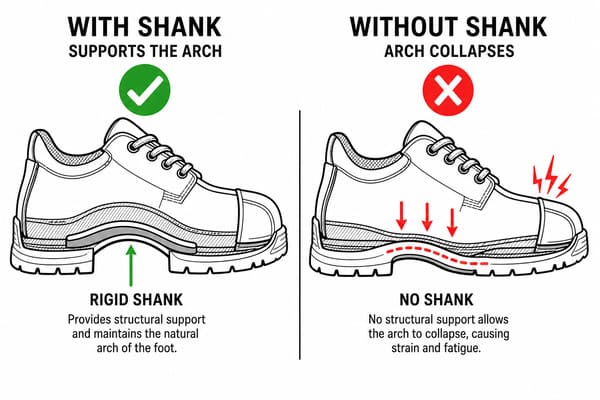
The shank acts as a bridge across the arch. It spans the gap between heel and toe, distributes load evenly through the foot, and keeps the foot in its natural alignment. Without it, the midsole compresses unevenly, the outsole warps, and the foot loses proper support with every step.
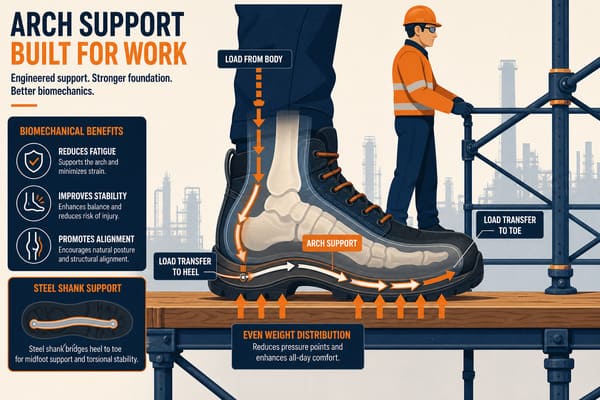
We have run internal wear tests on shoes with and without shanks under simulated daily load conditions. The results are not subtle. Shoes without shanks showed visible arch deformation within 60 days2. Workers wearing those shoes reported discomfort starting as early as week two. That is not a long time. Most workers expect a safety shoe to last 12 months or more. A shoe that fails structurally in two months is not just a comfort problem — it is a cost problem for the buyer and a health problem for the worker.
Why Arch Deformation Matters Beyond Comfort
When the arch of a safety shoe collapses, the damage goes further than the shoe itself.
| Effect | What Happens |
|---|---|
| Midsole compression | Load is no longer distributed evenly, pressure concentrates in one area |
| Outsole warping | The shoe loses flat ground contact, affecting slip resistance |
| Foot misalignment | Ankle, knee, and lower back begin compensating for lost arch support |
| Accelerated wear | The shoe breaks down faster from the inside out |
| Worker fatigue | Muscles work harder to stabilize a foot that the shoe is no longer supporting |
A shank prevents all of this. It is not a comfort upgrade. It is the part of the shoe that makes every other part work the way it is supposed to.
What Materials Are Safety Shoe Shanks Made From?
When a buyer tells me they want a lightweight safety shoe, the first thing I think about internally is the shank. Shank material is one of the biggest decisions in the design of any safety shoe.
Safety shoe shanks are made from four main materials: steel, fiberglass, nylon or plastic, and carbon fiber. Each material has a different weight, rigidity, conductivity, and cost profile. The right choice depends on the work environment, the weight target, and the performance level the shoe needs to meet.
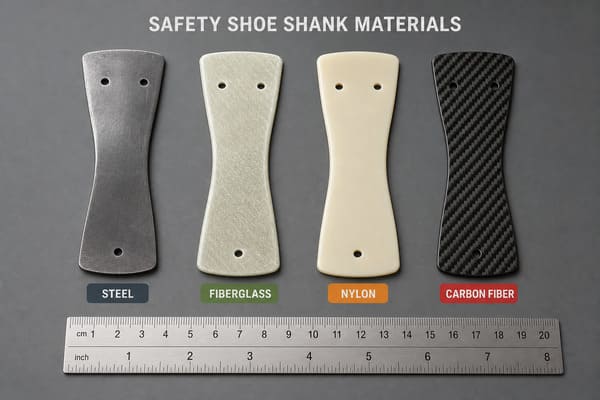
Here is how these four materials compare based on our actual production experience at Shoegan.
Shank Material Comparison: What the Differences Actually Mean
| Material | Weight | Rigidity | Cold Conductivity | Metal-Free | Relative Cost |
|---|---|---|---|---|---|
| Steel | Heavy (+80–120g) | Highest | Yes — conducts cold | No | Low |
| Fiberglass | ~40% lighter than steel | High | None | Yes | Medium |
| Nylon / Plastic | Lightest | Low | None | Yes | Lowest |
| Carbon Fiber | Similar to fiberglass | Equal to steel | None | Yes | High (3–5x steel) |
Steel shanks are the most common. They are strong and durable, and the cost at the component level is low. But in cold environments below -10°C, a steel shank conducts cold directly into the arch3. Workers feel it quickly. For electrical hazard zones or facilities that require workers to pass through metal detectors, steel is also the wrong choice.
Fiberglass shanks solve the conductivity problem. They are about 40% lighter than steel4 and carry no electrical or thermal risk. They are slightly less rigid under extreme load, but for most industrial environments, the difference is not meaningful in practice.
Nylon and plastic shanks are where I get cautious. They are cheap and light, but they flex too much under real industrial load.5 We only recommend them for light-duty environments or very short shifts. Some suppliers use them in shoes that look premium on the outside. Buyers should check this specifically when evaluating samples.
Carbon fiber is where we are seeing growing demand in the mid-to-high end market. One client based in Germany asked us to redesign their existing steel-shank model using a carbon fiber shank. The final shoe came out 180 grams lighter per pair6. Over an 8-hour shift with 8,000 to 10,000 steps, that difference is real to the worker wearing it.
Does Every Safety Shoe Need a Shank?
Not every safety shoe on the market includes one. And EN ISO 20345 does not list a shank as a standalone mandatory requirement7. So some suppliers skip it, especially at the lower price points.
Not every safety shoe requires a shank, but any shoe designed for workers who are on their feet for more than 6 hours a day does. Without a shank, the shoe cannot maintain its structure under the cumulative load of a full industrial shift. The shoe degrades faster, and so does the worker’s body.
In 15 years of production, I have never recommended a shank-free design to a buyer whose end users work on their feet through a full shift. The reasoning is simple arithmetic.
When a Shank Is Necessary vs. When It May Not Be
| Work Environment | Shift Length | Shank Required? |
|---|---|---|
| Construction, mining, industrial | 8+ hours | Yes — non-negotiable |
| Logistics, warehouse (active) | 6–8 hours | Yes — strongly recommended |
| Light manufacturing | 4–6 hours | Recommended, depending on floor surface |
| Mostly seated work, flat floor | Under 4 hours | Can be evaluated case by case |
A construction worker does roughly 8,000 to 10,000 steps per shift.8 Every step puts load through the arch. Without a shank, the shoe absorbs that load in ways it was not designed to handle. The shoe wears out faster. The worker’s foot suffers faster. And the buyer receives complaints and return requests that could have been avoided at the design stage.
The only situations where we would consider a shank-free design acceptable are very light-duty environments, flat warehouse floors with short shifts, or roles where the worker is mostly seated. The moment the work environment becomes more demanding than that, a shank is no longer optional.
Is Steel Shank the Same as Steel Toe?
A procurement manager once sent me a spec sheet that listed "steel shank" under the toe protection requirements column. I see this kind of confusion regularly, even from experienced buyers. It leads to misspecified orders, incorrect production runs, and re-quoting that delays the entire project.
No. A steel shank and a steel toe are two separate components with completely different functions. The steel toe cap sits at the front of the shoe and protects against impact and compression. The shank sits under the arch and provides structural support. They are independent components, and each is specified separately.
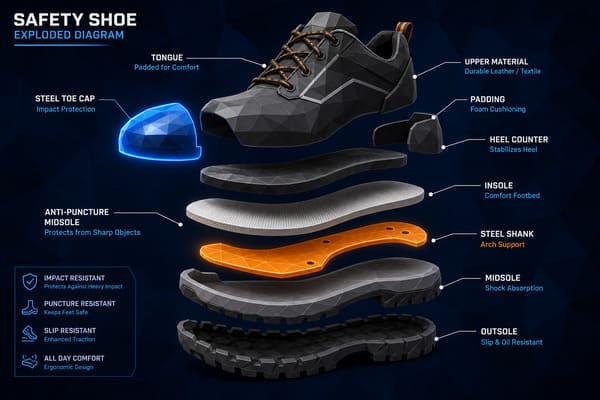
Under EN ISO 20345, the toe cap must withstand 200 joules of impact force. That is its job. The shank has nothing to do with impact resistance. It is about keeping the shoe’s structure intact and keeping the foot properly supported across the full length of the shoe.
Steel Toe vs. Steel Shank: A Clear Breakdown
| Component | Location | Function | Tested Under |
|---|---|---|---|
| Steel toe cap | Front of shoe | Impact and compression protection | EN ISO 20345 (200J impact) |
| Steel shank | Under the arch | Structural support, load distribution | No standalone standard — design choice |
| Composite toe cap | Front of shoe | Same as steel toe, lighter, non-metallic | EN ISO 20345 (same impact requirement) |
| Fiberglass or carbon shank | Under the arch | Same arch support role, different material | No standalone standard — design choice |
A shoe can have a composite toe cap with a steel shank. A shoe can have a steel toe cap with a fiberglass shank. These are independent decisions made based on what the job environment actually requires. Mixing them up in a specification does not just cause confusion — it changes the product you end up receiving. Getting this clear before you finalize any spec sheet saves time for everyone involved.
Conclusion
The shank is small, invisible, and easy to overlook — but it is what holds a safety shoe together under real working conditions. Specify it right, and everything else performs better.
At Shoegan, we help buyers make shank decisions that match their end users’ actual work environments — because a well-built shoe starts from the inside out.
-
"What is the shank of a boot?", https://thorogoodusa.com/what-is-a-boot-shank/. In footwear construction, the shank (also termed the waist stiffener) is a rigid or semi-rigid element inserted between the insole and outsole in the waist region of the shoe, serving to resist torsion and longitudinal bending; its dimensions vary by shoe last and intended load rating. Evidence role: definition; source type: encyclopedia. Supports: That a shank is a structural component placed in the waist of a shoe between the insole and outsole to support the arch.. Scope note: Standardized dimensional specifications for shanks are not universally codified; the 10–15 cm range reflects common production practice rather than a single authoritative source. ↩
-
"Testing the effects of footwear on biomechanics of human body – PMC", https://pmc.ncbi.nlm.nih.gov/articles/PMC11904544/. ISO and EN standards for occupational footwear, including ISO 20345 and related test methods, specify mechanical flexing and compression protocols designed to detect premature structural failure; results from these tests provide a benchmark against which internal wear observations can be contextualized. Evidence role: general_support; source type: institution. Supports: That standardized footwear durability tests measure deformation and structural degradation under simulated load cycles.. Scope note: The 60-day deformation finding cited in the article derives from internal testing whose methodology and conditions are not disclosed, limiting external comparability. ↩
-
"Footwear Safety Fact Sheet – Texas Department of Insurance", https://www.tdi.texas.gov/pubs/videoresource/fsfootwear.pdf. Steel exhibits a thermal conductivity of approximately 50 W/m·K, compared to less than 1 W/m·K for fiberglass composites, meaning metallic footwear components can act as a thermal bridge, accelerating heat loss from the foot in cold environments. Evidence role: mechanism; source type: research. Supports: That steel’s high thermal conductivity causes heat transfer from the foot to cold surroundings, making metallic components problematic in sub-zero work environments.. Scope note: The -10°C threshold cited in the article is an operational guideline; the degree of thermal discomfort depends on exposure duration, insulation layers, and individual physiology. ↩
-
"What Is the Difference Between a Fiberglass and a Carbon Fiber …", https://protectyourfootsafety.com/what-is-the-difference-between-a-fiberglass-and-a-carbon-fiber-toe-cap/. Steel has a density of approximately 7,850 kg/m³, while fiberglass-reinforced composites typically range from 1,600 to 2,000 kg/m³, yielding a mass reduction of roughly 74–80% by volume; however, component geometry and construction method determine actual weight savings in finished shank applications. Evidence role: mechanism; source type: encyclopedia. Supports: That fiberglass-reinforced composite materials are substantially lighter than steel by virtue of their lower density.. Scope note: The 40% figure cited in the article may reflect a specific shank geometry rather than raw material density ratios, so direct material data provides general rather than precise support. ↩
-
"What Is the Difference Between a Fiberglass and a Carbon Fiber …", https://protectyourfootsafety.com/what-is-the-difference-between-a-fiberglass-and-a-carbon-fiber-toe-cap/. Nylon (polyamide 6/6) has a flexural modulus of approximately 2.5–3.5 GPa, compared to approximately 200 GPa for steel and 20–50 GPa for fiberglass composites, indicating that nylon components deflect significantly more under equivalent bending loads. Evidence role: mechanism; source type: encyclopedia. Supports: That thermoplastic materials such as nylon have substantially lower flexural modulus than steel or fiberglass composites, resulting in greater deflection under equivalent load.. Scope note: Shank performance also depends on geometry, thickness, and boundary conditions within the shoe construction; raw modulus values provide a directional comparison rather than a direct prediction of in-shoe behavior. ↩
-
"Metabolic effects of carbon-plated running shoes: a systematic review …", https://pmc.ncbi.nlm.nih.gov/articles/PMC12827780/. Carbon fiber reinforced polymer has a density of approximately 1,500–1,600 kg/m³ versus approximately 7,850 kg/m³ for steel, enabling substantial mass reduction when used as a structural replacement; actual component weight savings depend on cross-sectional geometry and fiber layup. Evidence role: general_support; source type: encyclopedia. Supports: That substituting carbon fiber components for steel equivalents yields significant weight reductions owing to the lower density of carbon fiber composites.. Scope note: The 180-gram figure is specific to one manufacturer’s proprietary redesign and cannot be independently verified from material property data alone. ↩
-
"How Do You Choose a Safety Shoe Manufacturer in China …", https://protectyourfootsafety.com/how-do-you-choose-a-safety-shoe-manufacturer-in-china/. EN ISO 20345 establishes minimum performance requirements for safety footwear through functional tests (e.g., impact resistance, slip resistance, flexing resistance) rather than by mandating specific internal components such as shanks; compliance is assessed by test outcome rather than by prescriptive construction rules. Evidence role: general_support; source type: institution. Supports: That EN ISO 20345 specifies defined mandatory and optional performance requirements for safety footwear without enumerating every internal structural component.. Scope note: The full text of the most current edition of EN ISO 20345 should be consulted to confirm the absence of any shank-related clause, as standards are periodically revised. ↩
-
"Step Counting: A Review of Measurement Considerations and …", https://pmc.ncbi.nlm.nih.gov/articles/PMC5488109/. Occupational activity research has documented that workers in physically demanding trades can accumulate between 8,000 and 12,000 steps per shift, depending on role and site conditions; see, e.g., studies on occupational physical activity monitoring using pedometry. Evidence role: statistic; source type: research. Supports: That workers in physically demanding industries such as construction typically accumulate thousands of steps per work shift.. Scope note: Step counts vary substantially by trade, task, and site layout; a single figure may not represent all construction roles. ↩